Autonomy scoreLocal analysis
Nottingham Home autonomy potential in Nottingham (England)
The strongest asset here is Solar energy. It is not, however, what pays your home the most: that is Low-carbon heating.
Annual potential, standard home
£4,411
Four items added up — each one is a separate decision, in whatever order suits you.
Overall score
53 /100
Growing
Nottingham: 53/100 achievable autonomy with a recommended setup.
Solid potential — real, achievable gains in energy, water & food autonomy await.
What you could reach in Nottingham
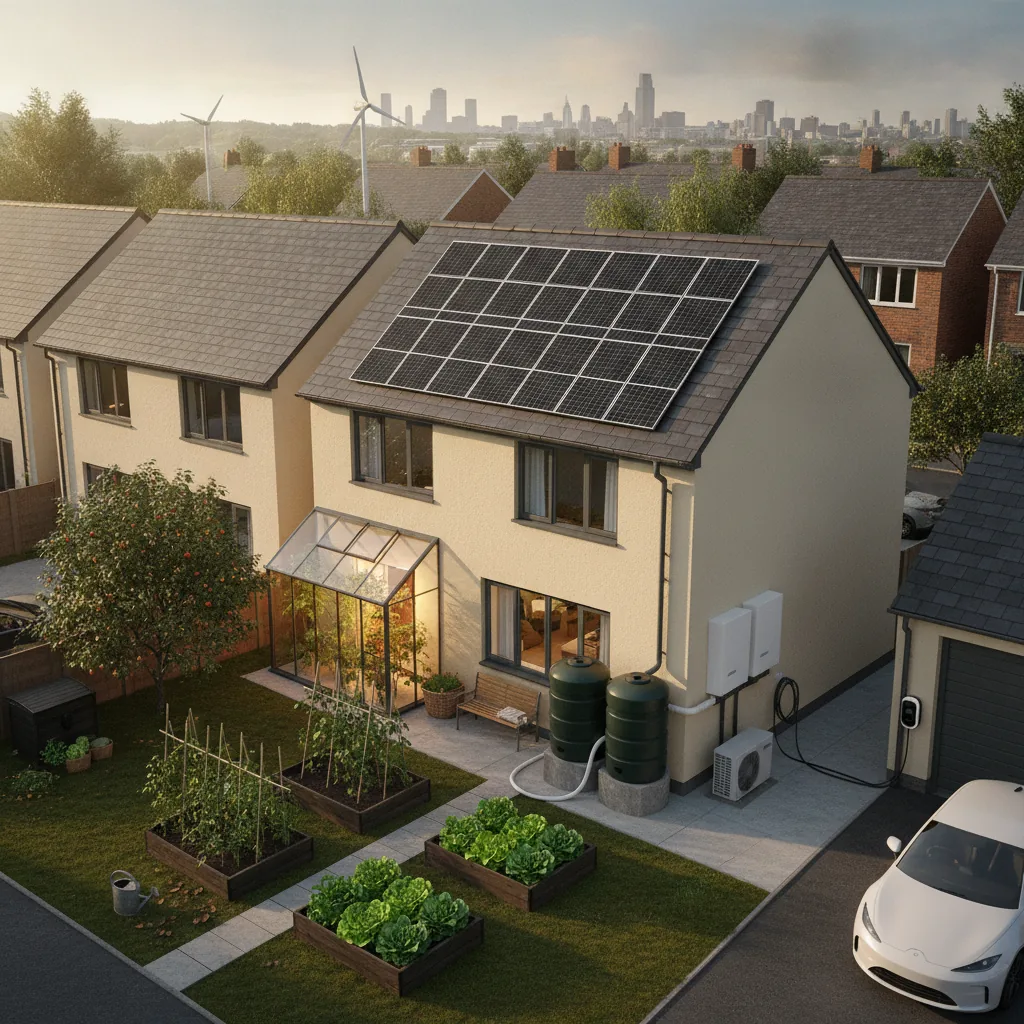
A typical home in Nottingham can reach about 53% self-sufficiency with a right-sized solar, storage, rainwater and low-carbon heating setup — much of it backed by UK grants and 0% VAT. The figure sharpens once you enter your own home.
- ≈207 days a year off the grid — keep the fridge, lights, router and heating pump running straight from your own roof and battery, right through a winter outage.
- Rainwater self-reliance — ≈66,215 L harvested from a 100 m² roof covers the garden and toilet flushing, so hosepipe bans stop mattering.
- A real harvest — ≈241 kg of fresh vegetables over a ≈213-day frost-free season takes a genuine bite out of the weekly shop.
- A warm, low-bill winter — insulation plus a right-sized heat pump turns the local climate into low-carbon comfort and shields you from gas-price spikes.
From the most to the least profitable, here
What you could gain
-
Low-carbon heating42/100
~£2,705/yr
less heating after insulation + heat pump (−9,360 kWh/yr on 90 m², electric heating)
The detail
Realistic outlook
2,990 heating-degree-days: a high-efficiency heat pump is the lowest-carbon way to keep Nottingham warm.
Watch-outs
A heat pump only pays off in a well-insulated envelope — insulate first, then size the unit.
Grants & tips
Boiler Upgrade Scheme: £7,500 towards an air-source heat pump (England & Wales); ECO4 and the Great British Insulation Scheme fund insulation, plus 0% VAT on heat pumps.
Heating-degree-days (base 18°C) : ≈ 2,990 HDD — Source: PVGIS, hourly ERA5 temperatures 2005–2015 (base 18°C).
-
Solar energy55/100
~£737/yr
less electricity with 3 kWp on your roof (≈2,946 kWh/yr)
The detail
Realistic outlook
At 982 kWh/kWp per year, Nottingham offers solid potential for residential rooftop solar.
Watch-outs
Roof orientation, shading and DNO connection rules affect real output — get an MCS-certified site assessment first.
Grants & tips
Smart Export Guarantee (SEG): your supplier pays for surplus solar exported to the grid, plus 0% VAT on residential solar PV and battery storage until 2027.
Annual PV yield : 982 kWh/kWp — Source: PVGIS 5.2 (EU Joint Research Centre), optimal tilt and local horizon.
-
Food growing55/100
~£709/yr
off the weekly shop — up to ≈241 kg/yr of fresh vegetables from 100 m²
The detail
Realistic outlook
With about 213 frost-free days, a household garden in Nottingham supports two planting rotations a year.
Watch-outs
A productive garden needs space, decent soil and a few hours a week — start small and scale up.
Grants & tips
Council allotments (Allotments Act) give cheap growing plots; RHS and community-garden schemes support home food production.
Frost-free growing season : ≈ 213 days — Source: PVGIS, hourly ERA5 temperatures 2005–2015 (frost dates).
-
Rainwater54/100
~£260/yr
less mains water with a 5,000 L tank (≈66,215 L/yr harvestable from a 100 m² roof)
The detail
Realistic outlook
779 mm of rain a year makes rooftop rainwater harvesting worthwhile in Nottingham.
Watch-outs
Harvested rain is non-potable by default — keep it separate from drinking water and add a first-flush diverter.
Grants & tips
Many UK water companies offer subsidised or free water butts; on a metered supply, harvested rainwater cuts your water bill directly.
Average annual rainfall : 779 mm — Source: NASA POWER, MERRA-2 corrected precipitation.
£4,411
Ranked by annual value. The order of the works themselves does not change: insulate before you equip.
Estimate for Nottingham, based on the area's climate and geographic data. Run the full simulation to get your home's real autonomy score — a personalized result and a detailed plan, in 3 minutes.
Everything is free — score, full report and action plan. No card, no commitment.
Estimate your solar system in Nottingham
Estimate your solar system in Nottingham
Based on a local yield of 982 kWh/kWp per year.
Indicative estimate (production = kWp × local yield). Real output depends on roof orientation, shading and your self-consumption rate.
What is specific to Nottingham
The St Mary's Inclosure Act of 1845 opened the Clay Fields to housing, and the council says the Arboretum Conservation Area, with its Victorian and Edwardian terraces, was shaped by the expansion that followed. In St Ann's, the "New Town" terraces were demolished under 1960s slum clearance and replaced from 1970 by a Radburn-style estate that Wimpey built using prefabricated methods. The city has 33 conservation areas, from the Lace Market to the Park beside the castle, and council guidance notes that local roofs mix blue slate, red clay tiles and pantiles.
That guidance, published in autumn 2025, says solar panels in conservation areas need planning permission on highly significant buildings or highly visible roof slopes, but not on less significant buildings or discreet slopes, and asks for neat, symmetrical arrays. Listed buildings need consent, with rear slopes and outbuildings preferred. External wall insulation may be accepted on rear or side walls out of public view, ideally in breathable natural fibres. Article 4 Directions also control minor works such as new windows and doors on some properties in Canning Circus, New Lenton, Sneinton, Strelley Village and Waterloo Promenade.
Nottingham was the first place in the UK to pilot Energiesprong, a Dutch whole-house retrofit: in 2017 Nottingham City Homes ordered ten pilot retrofits, wrapping homes in prefabricated insulated panels with solar roofs and heat pumps replacing gas, and by October 2021 the council reported 46 completed. For owner-occupiers and private tenants, the council's Greener HousiNG team runs the Warm Homes: Local Grant, with £7.4 million announced in February 2026 for more than 420 homes by March 2028, aimed at properties rated EPC D to G whose households earn under £36,000, claim certain benefits or live in an eligible postcode. Nottingham Energy Partnership, a Meadows-based charity, handles applications; the council warns of waits of up to a year.
More than 5,000 homes take heat from Enviroenergy, a network set up in 1972. A February 2025 heat network zoning report says the council runs it in-house, with steam from FCC Environment's Eastcroft energy-from-waste plant feeding the London Road Heat Station and over 85km of pipework from Crocus Street to Coppice Park in St Ann's; the steam contract runs to 2030, with future supply then under negotiation. The whole city is a smoke control area, where only authorised fuels or exempt appliances are allowed and fines reach £1,000 per offence.
Severn Trent took over the city's water supply from the City of Nottingham Water Department in 1974, and the Environment Agency declared drought across the East Midlands in July 2025. The Grade II*-listed St Ann's Allotments, where the Nottingham Independent Cottage Garden Society was granted 50 gardens in 1842, hold more than 700 plots across Hungerhill, Stonepit Coppice and Gorseyclose Gardens. Council direct-let plots cost 46p per square metre a year in 2024, but waits run from about two years to five.
Sources
- St Ann's, Nottingham – Wikipedia
- Nottingham's Conservation Areas – Nottingham City Council
- Nottingham Conservation Areas Guidance Note 2025+ – Nottingham City Council
- Conservation Areas and Listed Buildings – Nottingham City Council
- Restrictions on HMO and permitted development (Article 4) – Nottingham City Council
- Nottingham first to adopt revolutionary housing approach – Energiesprong (31 August 2017)
- Giant wall and roof panels to be craned in to make greener homes – My Nottingham News (4 October 2021)
- Greener HousiNG – Nottingham City Council
- Almost £18 million funding boost to make hundreds of Nottingham homes warmer – My Nottingham News (11 February 2026)
- NEP's Community Retrofit House – Nottingham Energy Partnership
- Nottingham Heat Network Zoning – Zone Opportunity Report (February 2025)
- Smoke Control Areas and Wood Burning Stoves – Nottingham City Council
- Nottingham – Wikipedia
- West and East Midlands move into drought – Environment Agency (15 July 2025)
- St Ann's Allotments – Wikipedia
- Allotments – Nottingham City Council
Facts checked on 21 October 2026.
Climate month by month in Nottingham
In Nottingham, a 3 kWp array pitched at 41° and facing 5° east of south — the optimum PVGIS computes for this location — produces about 2,946 kWh a year. May is the strongest month, at about 357 kWh, and December the weakest, at 111 kWh. November to February bring 18% of the year's output — enough for a battery to cover winter evenings on sunny days, not through grey spells.
The heating season runs from September to June: 10 months average below 15 °C, and February is the coldest at 4.0 °C. In a typical year the coldest hours drop to about -3 °C, the point a heat pump has to be sized for: a standard air-to-water heat pump copes comfortably in an insulated house.
Frost is possible until mid-April and returns from mid-November, which leaves about 213 frost-free days; tender crops such as tomatoes, beans and squash go outside once mid-April is past. Days above 30 °C are rare, so summer care is mostly steady watering.
Mean wind at 10 m is 4.2 m/s: borderline for a small turbine, which would need an exposed, unobstructed mast to pay off. The southern horizon is open (at most 1.1°) in PVGIS's elevation model, so low winter sun reaches roofs unless nearby buildings block it.
Compared with Derby, 22 km away, Nottingham has the same solar yield, as many frost-free days and a similar heating need. Compared with Leicester, 35 km away, Nottingham has 2% less solar yield, 8 fewer frost-free days and a similar heating need.
| Month | Mean temperature | Solar output, 3 kWp |
|---|---|---|
| January | 4.2 °C | 114 kWh |
| February | 4.0 °C | 159 kWh |
| March | 5.8 °C | 261 kWh |
| April | 8.7 °C | 327 kWh |
| May | 11.4 °C | 357 kWh |
| June | 14.5 °C | 333 kWh |
| July | 16.7 °C | 351 kWh |
| August | 16.0 °C | 324 kWh |
| September | 14.1 °C | 276 kWh |
| October | 11.3 °C | 192 kWh |
| November | 7.1 °C | 141 kWh |
| December | 4.6 °C | 111 kWh |
Frequently asked questions — Nottingham
How much could solar panels generate in Nottingham?
A well-oriented 3 kWp rooftop array in Nottingham produces about 2,946 kWh a year, worth roughly £737 in self-consumption. A 6 kWp system reaches about 5,892 kWh/yr where the roof allows. Smart Export Guarantee (SEG): your supplier pays for surplus solar exported to the grid, plus 0% VAT on residential solar PV and battery storage until 2027.
Is rainwater harvesting worth it in Nottingham?
Yes. A 60 m² roof in Nottingham can capture about 39,729 litres a year for the garden, WC and washing machine. Keep harvested rain separate from drinking water and fit a first-flush diverter. Many UK water companies offer subsidised or free water butts; on a metered supply, harvested rainwater cuts your water bill directly.
What grants help with low-carbon heating in Nottingham?
Boiler Upgrade Scheme: £7,500 towards an air-source heat pump (England & Wales); ECO4 and the Great British Insulation Scheme fund insulation, plus 0% VAT on heat pumps. Insulate first — a heat pump only pays off in a well-insulated home (2,990 heating-degree-days here), so prioritise the roof and walls before sizing the unit.
How much food can a garden grow in Nottingham?
With about 213 frost-free days, a 100 m² garden in Nottingham yields roughly 241 kg of fresh fruit and vegetables a year — a partial share of a household's needs, not full calorie autonomy. Council allotments (Allotments Act) give cheap growing plots; RHS and community-garden schemes support home food production.
When is the last frost in Nottingham?
Frost is possible until mid-April and returns from mid-November, which leaves about 213 frost-free days; tender crops such as tomatoes, beans and squash go outside once mid-April is past.
How much does solar produce in winter in Nottingham?
December is the weakest month: a 3 kWp array makes about 111 kWh, against 357 kWh in May. November to February add up to 18% of the yearly total.
How this score is calculated
Public climate data (PVGIS, European Commission) weighted by how vital each dimension is. The score sharpens once you enter your own home. See the full methodology.
Sources
- Solar energy — Source: PVGIS 5.2 (EU Joint Research Centre), optimal tilt and local horizon.
- Rainwater — Source: NASA POWER, MERRA-2 corrected precipitation.
- Food growing — Source: PVGIS, hourly ERA5 temperatures 2005–2015 (frost dates).
- Low-carbon heating — Source: PVGIS, hourly ERA5 temperatures 2005–2015 (base 18°C).
Already ran your simulation?
your score is saved and re-scored every time your home changes. No credit card required.