Autonomy scoreLocal analysis
Coventry Home autonomy potential in Coventry (England)
The strongest asset here is Food growing. It is not, however, what pays your home the most: that is Low-carbon heating.
Annual potential, standard home
£4,463
Four items added up — each one is a separate decision, in whatever order suits you.
Overall score
53 /100
Growing
Coventry: 53/100 achievable autonomy with a recommended setup.
Solid potential — real, achievable gains in energy, water & food autonomy await.
What you could reach in Coventry
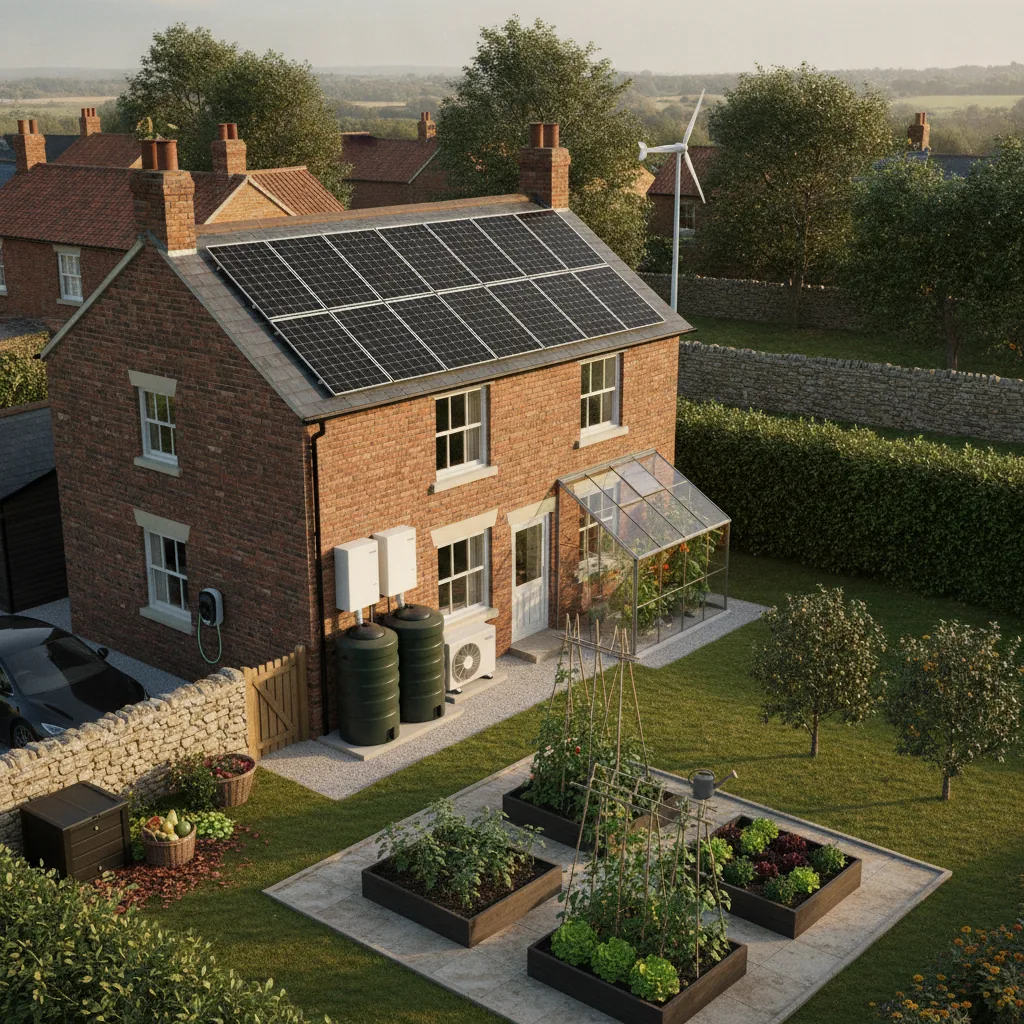
A typical home in Coventry can reach about 53% self-sufficiency with a right-sized solar, storage, rainwater and low-carbon heating setup — much of it backed by UK grants and 0% VAT. The figure sharpens once you enter your own home.
- ≈207 days a year off the grid — keep the fridge, lights, router and heating pump running straight from your own roof and battery, right through a winter outage.
- Rainwater self-reliance — ≈63,580 L harvested from a 100 m² roof covers the garden and toilet flushing, so hosepipe bans stop mattering.
- A real harvest — ≈248 kg of fresh vegetables over a ≈218-day frost-free season takes a genuine bite out of the weekly shop.
- A warm, low-bill winter — insulation plus a right-sized heat pump turns the local climate into low-carbon comfort and shields you from gas-price spikes.
From the most to the least profitable, here
What you could gain
-
Low-carbon heating41/100
~£2,731/yr
less heating after insulation + heat pump (−9,450 kWh/yr on 90 m², electric heating)
The detail
Realistic outlook
3,000 heating-degree-days: a high-efficiency heat pump is the lowest-carbon way to keep Coventry warm.
Watch-outs
A heat pump only pays off in a well-insulated envelope — insulate first, then size the unit.
Grants & tips
Boiler Upgrade Scheme: £7,500 towards an air-source heat pump (England & Wales); ECO4 and the Great British Insulation Scheme fund insulation, plus 0% VAT on heat pumps.
Heating-degree-days (base 18°C) : ≈ 3,000 HDD — Source: PVGIS, hourly ERA5 temperatures 2005–2015 (base 18°C).
-
Solar energy55/100
~£743/yr
less electricity with 3 kWp on your roof (≈2,970 kWh/yr)
The detail
Realistic outlook
At 990 kWh/kWp per year, Coventry offers solid potential for residential rooftop solar.
Watch-outs
Roof orientation, shading and DNO connection rules affect real output — get an MCS-certified site assessment first.
Grants & tips
Smart Export Guarantee (SEG): your supplier pays for surplus solar exported to the grid, plus 0% VAT on residential solar PV and battery storage until 2027.
Annual PV yield : 990 kWh/kWp — Source: PVGIS 5.2 (EU Joint Research Centre), optimal tilt and local horizon.
-
Food growing57/100
~£729/yr
off the weekly shop — up to ≈248 kg/yr of fresh vegetables from 100 m²
The detail
Realistic outlook
With about 218 frost-free days, a household garden in Coventry supports two planting rotations a year.
Watch-outs
A productive garden needs space, decent soil and a few hours a week — start small and scale up.
Grants & tips
Council allotments (Allotments Act) give cheap growing plots; RHS and community-garden schemes support home food production.
Frost-free growing season : ≈ 218 days — Source: PVGIS, hourly ERA5 temperatures 2005–2015 (frost dates).
-
Rainwater52/100
~£260/yr
less mains water with a 5,000 L tank (≈63,580 L/yr harvestable from a 100 m² roof)
The detail
Realistic outlook
748 mm of rain a year makes rooftop rainwater harvesting worthwhile in Coventry.
Watch-outs
Harvested rain is non-potable by default — keep it separate from drinking water and add a first-flush diverter.
Grants & tips
Many UK water companies offer subsidised or free water butts; on a metered supply, harvested rainwater cuts your water bill directly.
Average annual rainfall : 748 mm — Source: NASA POWER, MERRA-2 corrected precipitation.
£4,463
Ranked by annual value. The order of the works themselves does not change: insulate before you equip.
Estimate for Coventry, based on the area's climate and geographic data. Run the full simulation to get your home's real autonomy score — a personalized result and a detailed plan, in 3 minutes.
Everything is free — score, full report and action plan. No card, no commitment.
Estimate your solar system in Coventry
Estimate your solar system in Coventry
Based on a local yield of 990 kWh/kWp per year.
Indicative estimate (production = kWp × local yield). Real output depends on roof orientation, shading and your self-consumption rate.
What is specific to Coventry
Coventry's watch industry began around Spon Street and spread into two satellite developments, Chapelfields and Earlsdon, and about two-thirds of Earlsdon's population once worked in it. Earlsdon's core is small late Victorian and Edwardian terraces and semis in red-brown brick under plain clay tiles and Welsh slate; some on Berkeley Road South have upper-storey topshops. The raid of 14 November 1940 destroyed more than 4,300 homes in one night.
That heritage limits what can go on a roof. Earlsdon, one of the city's 19 conservation areas, has an Article 4 direction, confirmed in September 2022, removing permitted development rights for solar panels visible from the public realm, for changes to street-facing roof slopes and for chimneys. Its schedule names 38 streets, Albany Road and Mayfield Road among them, and the management plan lists external wall insulation and cladding among changes that have harmed the area's historic buildings. A direction for the Burges, Hales Street, Chauntry Place and Palmer Lane, confirmed in January 2026, goes further, covering solar panels with no visibility test, air-source heat pumps and wall-mounted car chargers.
The council's 15-year Strategic Energy Partnership with E.ON, running since 2023, is delivering the Warm Homes: Local Grant with Act on Energy in Hillfields, Upper Stoke and Lower Stoke, where eligible owner-occupiers and private tenants can get free measures such as wall insulation, solar panels or a heat pump. Hillfields has £3.6 million of it within a West Midlands Combined Authority-funded project, with retrofit work running to March 2028, and Kestrix thermal-camera drone surveys have shown where its homes lose heat.
Bring Energy is expanding the Heatline network, which carries heat recovered at the Energy from Waste plant on London Road to the Council House, the Wave, the Cathedral and Friargate. In April 2026 the first phase went live at Coventry University, moving 11 buildings off gas boilers, and pipework laid through Hillfields could later connect community buildings and homes. Coventry is also a government heat network zoning pilot. The whole city is a smoke control area: letting a stove or fire give off significant smoke risks a fine of up to £1,000.
Severn Trent, the city's water supplier, saw record demand across its region on 11 July 2026, during a heatwave; with no restrictions in place, it asked customers to use water wisely. Allotments are let through the Coventry and District Allotments and Gardens Council for £15 to £46 a year, less with a Go CV+ discount; the council's directory lists more than 40 sites, including the 102-plot Baginton Mill Leisure Gardens. The E.ON-funded Coventry Grows project, run with Grapevine and Garden Organic (based at nearby Ryton Gardens), is creating or expanding community gardens at Stoke Heath, Hillfields, Templars and Foleshill. A council policy opening under-used land to community growing is due in autumn 2026.
Sources
- Earlsdon Conservation Area Appraisal (Coventry City Council)
- Coventry Blitz (Wikipedia)
- List of conservation areas (Coventry City Council)
- Article 4 Direction - Earlsdon Conservation Area (Coventry City Council)
- Earlsdon Conservation Area Management Plan (Coventry City Council)
- Article 4 Directions (Coventry City Council)
- Article 4 Direction - Lady Herbert's Garden and The Burges (Coventry City Council)
- Strategic Energy Partnership overview (Coventry City Council)
- Strategic Energy Partnership (Coventry City Council)
- Warm Homes: Local Grant (Coventry City Council)
- Hillfields neighbourhood improvements (Coventry City Council)
- Hillfields Home Energy Improvements - Warm Homes: Local Grant (Coventry City Council)
- Strategic Energy Partnership - Heat (Coventry City Council)
- Low-carbon heat network goes live at Coventry University (Coventry University, 15 April 2026)
- Smoke control areas - Open fires and wood-burning stoves (Coventry City Council)
- Water demand reaches highest level on record (Severn Trent, 16 July 2026)
- Pictures show parched Warwickshire landscape as warning issued over water use (CoventryLive, 16 July 2026)
- Allotments (Coventry City Council)
- Allotments in Coventry directory search (Coventry City Council)
- Baginton Mill Leisure Gardens - Allotments in Coventry (Coventry City Council)
- Coventry Grows (Coventry City Council)
- Visit our garden (Garden Organic)
Facts checked on 21 October 2026.
Climate month by month in Coventry
In Coventry, a 3 kWp array pitched at 40° and facing 5° east of south — the optimum PVGIS computes for this location — produces about 2,970 kWh a year. July is the strongest month, at about 357 kWh, and December the weakest, at 111 kWh. November to February bring 18% of the year's output — enough for a battery to cover winter evenings on sunny days, not through grey spells.
The heating season runs from September to June: 10 months average below 15 °C, and February is the coldest at 4.0 °C. In a typical year the coldest hours drop to about -3 °C, the point a heat pump has to be sized for: a standard air-to-water heat pump copes comfortably in an insulated house.
Frost is possible until early April and returns from mid-November, which leaves about 218 frost-free days; tender crops such as tomatoes, beans and squash go outside once early April is past. Days above 30 °C are rare, so summer care is mostly steady watering.
With a mean wind of 3.8 m/s at 10 m, a small rooftop turbine would produce little in Coventry; the roof is better used for solar. The southern horizon is open (at most 2.3°) in PVGIS's elevation model, so low winter sun reaches roofs unless nearby buildings block it.
Compared with Birmingham, 27 km away, Coventry has 2% more solar yield, 14 more frost-free days and a heating need 3% lower. Compared with Leicester, 36 km away, Coventry has 1% less solar yield, 3 fewer frost-free days and a similar heating need.
| Month | Mean temperature | Solar output, 3 kWp |
|---|---|---|
| January | 4.2 °C | 117 kWh |
| February | 4.0 °C | 165 kWh |
| March | 5.7 °C | 264 kWh |
| April | 8.7 °C | 327 kWh |
| May | 11.4 °C | 351 kWh |
| June | 14.5 °C | 345 kWh |
| July | 16.6 °C | 357 kWh |
| August | 15.8 °C | 321 kWh |
| September | 14.0 °C | 279 kWh |
| October | 11.3 °C | 192 kWh |
| November | 7.1 °C | 138 kWh |
| December | 4.6 °C | 111 kWh |
Frequently asked questions — Coventry
How much could solar panels generate in Coventry?
A well-oriented 3 kWp rooftop array in Coventry produces about 2,970 kWh a year, worth roughly £743 in self-consumption. A 6 kWp system reaches about 5,940 kWh/yr where the roof allows. Smart Export Guarantee (SEG): your supplier pays for surplus solar exported to the grid, plus 0% VAT on residential solar PV and battery storage until 2027.
Is rainwater harvesting worth it in Coventry?
Yes. A 60 m² roof in Coventry can capture about 38,148 litres a year for the garden, WC and washing machine. Keep harvested rain separate from drinking water and fit a first-flush diverter. Many UK water companies offer subsidised or free water butts; on a metered supply, harvested rainwater cuts your water bill directly.
What grants help with low-carbon heating in Coventry?
Boiler Upgrade Scheme: £7,500 towards an air-source heat pump (England & Wales); ECO4 and the Great British Insulation Scheme fund insulation, plus 0% VAT on heat pumps. Insulate first — a heat pump only pays off in a well-insulated home (3,000 heating-degree-days here), so prioritise the roof and walls before sizing the unit.
How much food can a garden grow in Coventry?
With about 218 frost-free days, a 100 m² garden in Coventry yields roughly 248 kg of fresh fruit and vegetables a year — a partial share of a household's needs, not full calorie autonomy. Council allotments (Allotments Act) give cheap growing plots; RHS and community-garden schemes support home food production.
When is the last frost in Coventry?
Frost is possible until early April and returns from mid-November, which leaves about 218 frost-free days; tender crops such as tomatoes, beans and squash go outside once early April is past.
How much does solar produce in winter in Coventry?
December is the weakest month: a 3 kWp array makes about 111 kWh, against 357 kWh in July. November to February add up to 18% of the yearly total.
How this score is calculated
Public climate data (PVGIS, European Commission) weighted by how vital each dimension is. The score sharpens once you enter your own home. See the full methodology.
Sources
- Solar energy — Source: PVGIS 5.2 (EU Joint Research Centre), optimal tilt and local horizon.
- Rainwater — Source: NASA POWER, MERRA-2 corrected precipitation.
- Food growing — Source: PVGIS, hourly ERA5 temperatures 2005–2015 (frost dates).
- Low-carbon heating — Source: PVGIS, hourly ERA5 temperatures 2005–2015 (base 18°C).
Already ran your simulation?
your score is saved and re-scored every time your home changes. No credit card required.