Autonomy scoreLocal analysis
Fort Worth Home autonomy potential in Fort Worth (76102)
The strongest asset here is Low-carbon heating. It is not, however, what pays your home the most: that is Food growing.
Annual potential, standard home
$2,322
Four items added up — each one is a separate decision, in whatever order suits you.
Overall score
59 /100
Growing
Fort Worth: 59/100 achievable autonomy with a recommended setup.
Solid potential — real, achievable gains in energy, water & food autonomy await.
What you could reach in Fort Worth
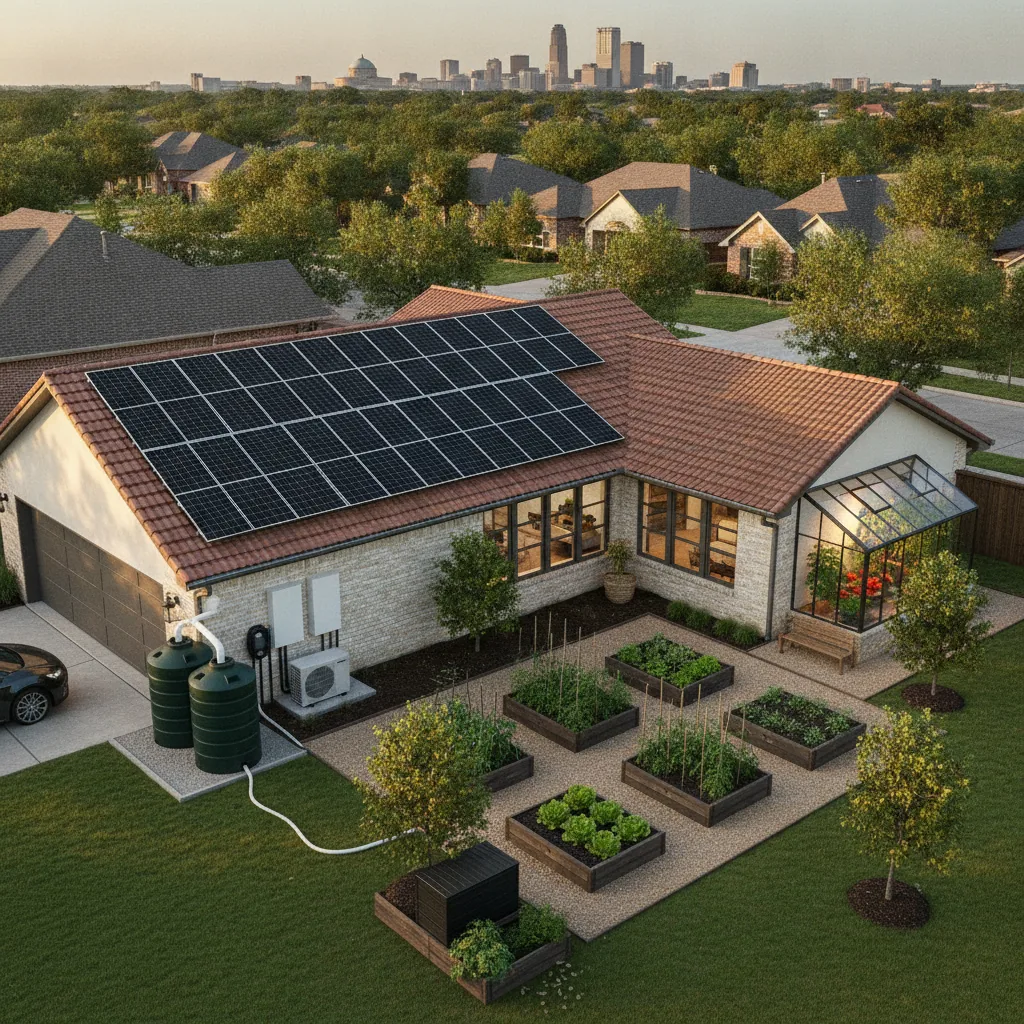
A typical home in Fort Worth can reach about 59% self-sufficiency with a right-sized solar, storage, rainwater and low-carbon heating setup — most of it backed by federal tax credits. The figure sharpens once you enter your own home.
- ≈174 days a year off the grid — keep the fridge, lights, router and heating pump running straight from your own roof and battery, right through a winter outage.
- Rainwater self-reliance — ≈72,930 L harvested from a 100 m² roof covers the garden and toilet flushing, so hosepipe bans stop mattering.
- A real harvest — ≈320 kg of fresh vegetables over a ≈284-day frost-free season takes a genuine bite out of the weekly shop.
- A warm, low-bill winter — insulation plus a right-sized heat pump turns the local climate into low-carbon comfort and shields you from gas-price spikes.
From the most to the least profitable, here
What you could gain
-
Food growing70/100
~$896/yr
off the weekly shop — up to ≈320 kg/yr of fresh vegetables from 100 m²
The detail
Realistic outlook
With about 284 frost-free days, a household garden in Fort Worth supports up to three planting rotations a year.
Watch-outs
A productive garden needs space, decent soil and a few hours a week — start small and scale up.
Incentives & tips
USDA People's Garden and many municipal community-garden and composting programs support home food production.
Frost-free growing season : ≈ 284 days — Source: PVGIS, hourly ERA5 temperatures 2005–2015 (frost dates).
-
Solar energy40/100
~$617/yr
less electricity with 3 kWp on your roof (≈4,749 kWh/yr)
The detail
Realistic outlook
At 1,583 kWh/kWp per year, Fort Worth offers moderate potential for residential rooftop solar.
Watch-outs
Roof orientation, shading and local interconnection rules affect real output — get a site assessment first.
Incentives & tips
Federal Residential Clean Energy Credit (IRA §25D): 30% tax credit on solar PV and battery storage through 2032.
Annual PV yield : 1,583 kWh/kWp — Source: PVGIS 5.2 (EU Joint Research Centre), optimal tilt and local horizon.
-
Low-carbon heating90/100
~$609/yr
less heating after insulation + heat pump (−3,690 kWh/yr on 90 m², electric heating)
The detail
Realistic outlook
1,160 heating-degree-days: a high-efficiency heat pump is the lowest-carbon way to keep Fort Worth warm.
Watch-outs
A heat pump only pays off in a well-insulated envelope — insulate first, then size the unit.
Incentives & tips
Energy Efficient Home Improvement Credit (§25C): up to $2,000/yr for heat pumps plus credits for insulation; HEEHRA state rebates may stack.
Heating-degree-days (base 18°C) : ≈ 1,160 HDD — Source: PVGIS, hourly ERA5 temperatures 2005–2015 (base 18°C).
-
Rainwater60/100
~$200/yr
less mains water with a 5,000 L tank (≈72,930 L/yr harvestable from a 100 m² roof)
The detail
Realistic outlook
858 mm of rain a year makes rooftop rainwater harvesting worthwhile in Fort Worth.
Watch-outs
Harvested rain is non-potable by default — keep it separate from drinking water and add a first-flush diverter.
Incentives & tips
Rainwater incentives vary by state — e.g. Texas sales-tax exemption on harvesting equipment, local rebates in Arizona. Check state and city programs.
Average annual rainfall : 858 mm — Source: NASA POWER, MERRA-2 corrected precipitation.
$2,322
Ranked by annual value. The order of the works themselves does not change: insulate before you equip.
Estimate for Fort Worth, based on the area's climate and geographic data. Run the full simulation to get your home's real autonomy score — a personalized result and a detailed plan, in 3 minutes.
Everything is free — score, full report and action plan. No card, no commitment.
Estimate your solar system in Fort Worth
Estimate your solar system in Fort Worth
Based on a local yield of 1,583 kWh/kWp per year.
Indicative estimate (production = kWp × local yield). Real output depends on roof orientation, shading and your self-consumption rate.
What is specific to Fort Worth
Arlington Heights, where the Army trained troops at Camp Bowie during World War I, filled with bungalows in the 1920s and 1930s. The Fairmount–Southside Historic District covers some 340 acres of late Victorian and early 20th-century buildings. In districts such as Fairmount and Mistletoe Heights, the Historic and Cultural Landmarks Commission or the city's preservation officer reviews changes to houses. In March 2025, the commission voted 8-0 against replacing wood windows at an Elizabeth Boulevard house after the officer judged them repairable. Owners who finish required restoration can seek a historic site tax exemption, which the commission recommends to the City Council.
Fort Worth is in Oncor's territory, so going solar involves two companies. Oncor, which runs the wires, studies the installer's interconnection application, grants permission to operate and requires an advanced meter to record surplus power. What that surplus earns depends on the retail electric provider, since only some offer buyback plans. Backup power gained urgency after the February 2021 winter storm, when outages at city water plants led to boil-water instructions for more than 300,000 residents. By March 2024, the city had spent $64.4 million on contracts for backup power, weatherproof enclosures and added Oncor service.
The Tarrant Regional Water District supplies Fort Worth, and two East Texas reservoirs, Richland-Chambers and Cedar Creek, provide 80% of Tarrant County's water. City rules limit lawn watering to twice a week and ban it from 10 a.m. to 6 p.m.; since March 2025, a warning has been followed by fines starting at $25. At a Sept. 26, 2026, workshop at the district's East Northside Drive offices, county residents could build a rain barrel for $25. The district's fall 2026 Go N Grow round offered the first 50 approved households a $95 rebate on a native garden for removing at least 125 square feet of turf.
The 2016 urban agriculture ordinance, as revised in 2020, lets farms skip rezoning by meeting 15 requirements and getting a site plan approved by Development Services. It can take years: Grow Southeast began the process for Tabor Farms, 2.5 acres on East Berry Street, in 2018 and was still finishing it in April 2023. Tarrant Area Food Bank's Community Garden Network counted 48 gardens in 2024, when its volunteers were helping Ridglea Christian Church grow sweet potatoes, eggplant and okra.
The Barnett Shale lies beneath the city, which had more than 1,000 natural-gas wells in December 2009. A 2021 state law bars Texas cities from restricting utility connections by energy source, so Fort Worth cannot ban gas in new homes. With a federal Energy Efficiency and Conservation Block Grant, the city had mailed 143,000 postcards to about 55% of residential parcels by January 2026. Each links by QR code to a sustainability website listing existing city rebate programs.
Sources
- Where I Live: Arlington Heights neighbors build their lives around its art, food and history (Fort Worth Report, July 11, 2026)
- Fairmount–Southside Historic District (Wikipedia)
- What Fort Worth's historic commission decided for four neighborhoods in September (Fort Worth Report, Oct. 3, 2026)
- Where I Live: Mistletoe Heights sees history, community run deep (Fort Worth Report, June 6, 2026)
- Documenters: Fort Worth Historic & Cultural Landmarks Commission, March 10, 2025 (Fort Worth Report)
- Oncor - Thinking About Solar? (residential and small commercial)
- Oncor Electric Delivery (Wikipedia)
- Three years after blackouts, Fort Worth water spends $64M to withstand future outages (Fort Worth Report, March 4, 2024)
- As Tarrant County experiences drought, officials consider new ways to conserve water (Fort Worth Report, Sept. 8, 2024)
- North Texas is enduring abnormally dry conditions. What does this mean for Tarrant waterways? (Fort Worth Report, Aug. 17, 2026)
- Will Fort Worth cut off those who overwatered lawns? Violators risk losing supply (Fort Worth Report, Nov. 6, 2025)
- Water advisers examine conservation, regulation of data center usage (Fort Worth Report, July 11, 2026)
- DIY Rainwater Harvesting, Sept. 26, 2026 - Save Tarrant Water event
- Native Texas Landscape Incentive Program - Save Tarrant Water
- Green thumbs meet red tape: After years of delays, a nonprofit wants to make it easier to farm in Fort Worth (Fort Worth Report, April 26, 2023)
- Fort Worth church keeps garden growing as Tarrant food bank is transplanted elsewhere (Fort Worth Report, Aug. 31, 2024)
- Fort Worth, Texas (Wikipedia)
- Texas Legislature Online - HB 17 (87R) bill history
- Texas Legislature - HB 17 (87R) enrolled text
- Fort Worth ranks behind Texas cities in reducing pollution and expanding clean energy. Here's why (Fort Worth Report, Feb. 2, 2022)
- $10M from federal grants aimed at bettering Fort Worth recycling, energy efficiency (Fort Worth Report, Jan. 30, 2026)
Facts checked on October 21, 2026.
Climate month by month in Fort Worth
In Fort Worth, a 3 kWp array pitched at 31° and facing 2° west of south — the optimum PVGIS computes for this location — produces about 4,749 kWh a year. August is the strongest month, at about 444 kWh, and December the weakest, at 333 kWh. November to February still bring 29% of the year's output, so the system stays useful all winter and a battery pays its way year-round.
The heating season runs from November to March: 5 months average below 59 °F (15 °C), and January is the coldest at 46 °F (8.0 °C). In a typical year the coldest hours drop to about 28 °F (-2 °C), the point a heat pump has to be sized for: a standard air-to-water heat pump copes comfortably in an insulated house.
Frost is possible until early March and returns from early December, which leaves about 284 frost-free days; tender crops such as tomatoes, beans and squash go outside once early March is past. Expect about 125 days above 86 °F (30 °C): shade netting and mulch matter as much as frost protection, and the water tank is drawn hardest in August.
With a mean wind of 9 mph (3.9 m/s) at 10 m, a small rooftop turbine would produce little in Fort Worth; the roof is better used for solar. The southern horizon is open (at most 4.2°) in PVGIS's elevation model, so low winter sun reaches roofs unless nearby buildings block it.
Compared with Dallas, 31 miles away, Fort Worth has 3% more solar yield, as many frost-free days and a heating need 2% higher. Compared with Austin, 174 miles away, Fort Worth has 5% more solar yield, 19 fewer frost-free days and a heating need 40% higher.
| Month | Mean temperature | Solar output, 3 kWp |
|---|---|---|
| January | 46 °F (8.0 °C) | 363 kWh |
| February | 49 °F (9.6 °C) | 339 kWh |
| March | 58 °F (14.6 °C) | 408 kWh |
| April | 67 °F (19.2 °C) | 417 kWh |
| May | 74 °F (23.2 °C) | 414 kWh |
| June | 83 °F (28.2 °C) | 429 kWh |
| July | 86 °F (29.9 °C) | 435 kWh |
| August | 87 °F (30.7 °C) | 444 kWh |
| September | 80 °F (26.4 °C) | 399 kWh |
| October | 68 °F (20.2 °C) | 411 kWh |
| November | 58 °F (14.2 °C) | 363 kWh |
| December | 48 °F (8.8 °C) | 333 kWh |
Frequently asked questions — Fort Worth
How much could solar panels generate in Fort Worth?
A well-oriented 3 kWp rooftop array in Fort Worth produces about 4,749 kWh a year, worth roughly $617 in self-consumption. A 6 kWp system reaches about 9,498 kWh/yr where the roof allows. Federal Residential Clean Energy Credit (IRA §25D): 30% tax credit on solar PV and battery storage through 2032.
Is rainwater harvesting worth it in Fort Worth?
Yes. A 60 m² roof in Fort Worth can capture about 43,758 litres a year for the garden, WC and washing machine. Keep harvested rain separate from drinking water and fit a first-flush diverter. Rainwater incentives vary by state — e.g. Texas sales-tax exemption on harvesting equipment, local rebates in Arizona. Check state and city programs.
What grants help with low-carbon heating in Fort Worth?
Energy Efficient Home Improvement Credit (§25C): up to $2,000/yr for heat pumps plus credits for insulation; HEEHRA state rebates may stack. Insulate first — a heat pump only pays off in a well-insulated home (1,160 heating-degree-days here), so prioritise the roof and walls before sizing the unit.
How much food can a garden grow in Fort Worth?
With about 284 frost-free days, a 100 m² garden in Fort Worth yields roughly 320 kg of fresh fruit and vegetables a year — a partial share of a household's needs, not full calorie autonomy. USDA People's Garden and many municipal community-garden and composting programs support home food production.
When is the last frost in Fort Worth?
Frost is possible until early March and returns from early December, which leaves about 284 frost-free days; tender crops such as tomatoes, beans and squash go outside once early March is past.
How much does solar produce in winter in Fort Worth?
December is the weakest month: a 3 kWp array makes about 333 kWh, against 444 kWh in August. November to February add up to 29% of the yearly total.
How this score is calculated
Public climate data (PVGIS with NREL's NSRDB radiation) weighted by how vital each dimension is. The score sharpens once you enter your own home. See the full methodology.
Sources
- Solar energy — Source: PVGIS 5.2 (EU Joint Research Centre), optimal tilt and local horizon.
- Rainwater — Source: NASA POWER, MERRA-2 corrected precipitation.
- Food growing — Source: PVGIS, hourly ERA5 temperatures 2005–2015 (frost dates).
- Low-carbon heating — Source: PVGIS, hourly ERA5 temperatures 2005–2015 (base 18°C).
Already ran your simulation?
your score is saved and re-scored every time your home changes. No credit card required.