Autonomy scoreLocal analysis
Dallas Home autonomy potential in Dallas (75201)
The strongest asset here is Low-carbon heating. It is not, however, what pays your home the most: that is Food growing.
Annual potential, standard home
$2,276
Four items added up — each one is a separate decision, in whatever order suits you.
Overall score
59 /100
Growing
Dallas: 59/100 achievable autonomy with a recommended setup.
Solid potential — real, achievable gains in energy, water & food autonomy await.
What you could reach in Dallas
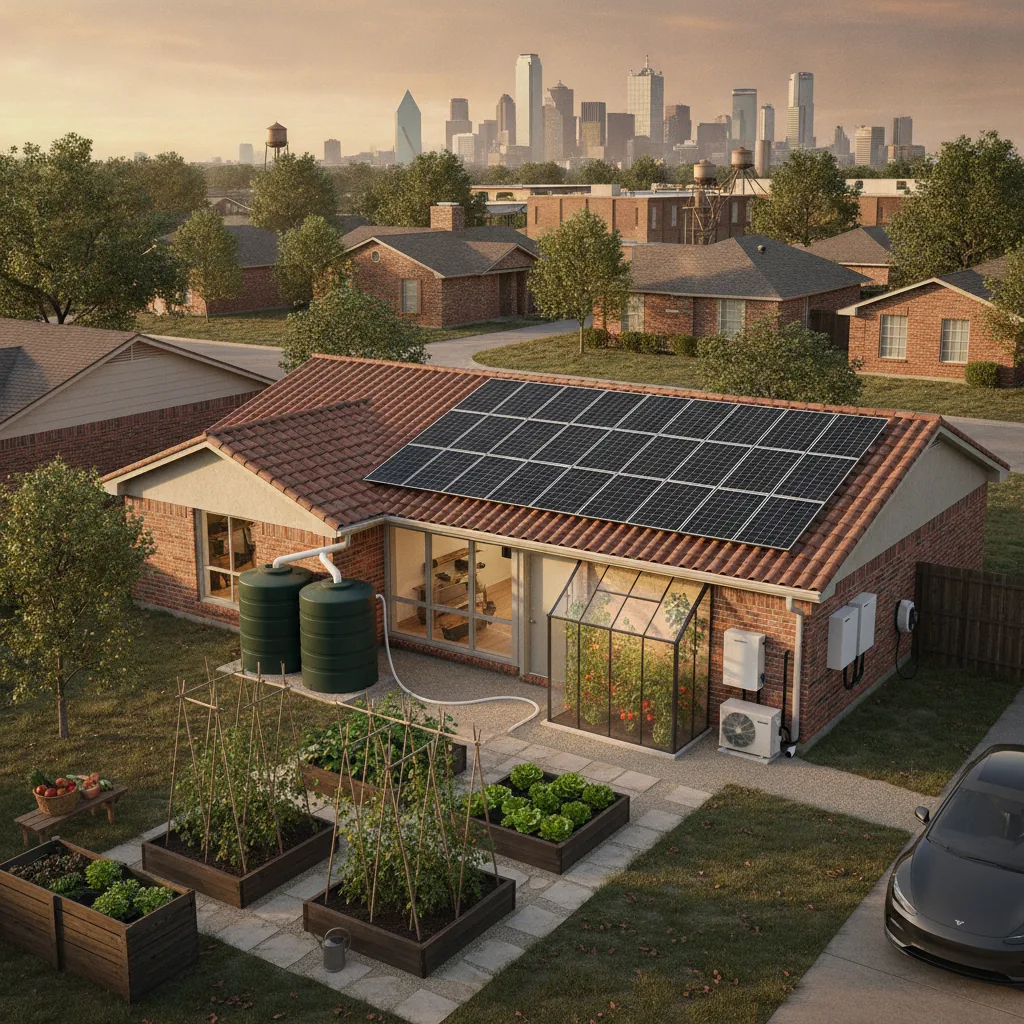
A typical home in Dallas can reach about 59% self-sufficiency with a right-sized solar, storage, rainwater and low-carbon heating setup — most of it backed by federal tax credits. The figure sharpens once you enter your own home.
- ≈172 days a year off the grid — keep the fridge, lights, router and heating pump running straight from your own roof and battery, right through a winter outage.
- Rainwater self-reliance — ≈78,285 L harvested from a 100 m² roof covers the garden and toilet flushing, so hosepipe bans stop mattering.
- A real harvest — ≈320 kg of fresh vegetables over a ≈284-day frost-free season takes a genuine bite out of the weekly shop.
- A warm, low-bill winter — insulation plus a right-sized heat pump turns the local climate into low-carbon comfort and shields you from gas-price spikes.
From the most to the least profitable, here
What you could gain
-
Food growing70/100
~$896/yr
off the weekly shop — up to ≈320 kg/yr of fresh vegetables from 100 m²
The detail
Realistic outlook
With about 284 frost-free days, a household garden in Dallas supports up to three planting rotations a year.
Watch-outs
A productive garden needs space, decent soil and a few hours a week — start small and scale up.
Incentives & tips
USDA People's Garden and many municipal community-garden and composting programs support home food production.
Frost-free growing season : ≈ 284 days — Source: PVGIS, hourly ERA5 temperatures 2005–2015 (frost dates).
-
Solar energy39/100
~$601/yr
less electricity with 3 kWp on your roof (≈4,620 kWh/yr)
The detail
Realistic outlook
At 1,540 kWh/kWp per year, Dallas offers moderate potential for residential rooftop solar.
Watch-outs
Roof orientation, shading and local interconnection rules affect real output — get a site assessment first.
Incentives & tips
Federal Residential Clean Energy Credit (IRA §25D): 30% tax credit on solar PV and battery storage through 2032.
Annual PV yield : 1,540 kWh/kWp — Source: PVGIS 5.2 (EU Joint Research Centre), optimal tilt and local horizon.
-
Low-carbon heating90/100
~$579/yr
less heating after insulation + heat pump (−3,510 kWh/yr on 90 m², electric heating)
The detail
Realistic outlook
1,140 heating-degree-days: a high-efficiency heat pump is the lowest-carbon way to keep Dallas warm.
Watch-outs
A heat pump only pays off in a well-insulated envelope — insulate first, then size the unit.
Incentives & tips
Energy Efficient Home Improvement Credit (§25C): up to $2,000/yr for heat pumps plus credits for insulation; HEEHRA state rebates may stack.
Heating-degree-days (base 18°C) : ≈ 1,140 HDD — Source: PVGIS, hourly ERA5 temperatures 2005–2015 (base 18°C).
-
Rainwater64/100
~$200/yr
less mains water with a 5,000 L tank (≈78,285 L/yr harvestable from a 100 m² roof)
The detail
Realistic outlook
921 mm of rain a year makes rooftop rainwater harvesting worthwhile in Dallas.
Watch-outs
Harvested rain is non-potable by default — keep it separate from drinking water and add a first-flush diverter.
Incentives & tips
Rainwater incentives vary by state — e.g. Texas sales-tax exemption on harvesting equipment, local rebates in Arizona. Check state and city programs.
Average annual rainfall : 921 mm — Source: NASA POWER, MERRA-2 corrected precipitation.
$2,276
Ranked by annual value. The order of the works themselves does not change: insulate before you equip.
Estimate for Dallas, based on the area's climate and geographic data. Run the full simulation to get your home's real autonomy score — a personalized result and a detailed plan, in 3 minutes.
Everything is free — score, full report and action plan. No card, no commitment.
Estimate your solar system in Dallas
Estimate your solar system in Dallas
Based on a local yield of 1,540 kWh/kWp per year.
Indicative estimate (production = kWp × local yield). Real output depends on roof orientation, shading and your self-consumption rate.
What is specific to Dallas
Munger Place in East Dallas, laid out around 1905 by cotton-gin maker Robert S. Munger and his brother Collett, has more than 200 homes the city calls the largest intact collection of Prairie-influenced houses in North Texas. Neighboring Junius Heights, a 1906 streetcar subdivision, has more than 800 Craftsman, Prairie and Tudor houses. In all 21 Landmark Districts, exterior work needs a Certificate of Appropriateness, but the Office of Historic Preservation lists solar panels and skylights as common Routine Maintenance items that staff can approve within 21 days, without a Landmark Commission hearing, if the project qualifies.
Since September 1, 2025, Senate Bill 1202 has let contractors hire a qualified third party to review and inspect solar and battery systems; once that review is approved, the city must issue the permit within three business days. Zoning, building-code and fire reviews still apply, with a $577 plan-review fee, and any panelboard change needs its own electrical permit. Landmarks and contributing houses can also qualify for city rehabilitation tax exemptions, renewed yearly with the appraisal district. For 2026, Oncor budgeted $1,774,000 for residential solar incentives, paid first-come, first-served through participating installers until November 30 or until the money runs out.
Dallas Water Utilities has limited sprinklers to two days a week since April 23, 2012, never on Mondays, Tuesdays or Fridays or from 10 a.m. to 6 p.m., with fines of $250 to $2,000 after a warning. Vegetable gardens can be watered any day by hand, soaker hose or drip, and rainwater, well water and graywater are exempt, though a permanently installed system needs a building permit and a small purple sign. Stage 1 of the 2024 Drought Contingency Plan can start when the eastern lakes (Ray Hubbard, Tawakoni, Fork) or western lakes (Ray Roberts, Lewisville, Grapevine) fall below 65 percent of DWU's storage share; Stage 3 can ban watering lawns and beds, leaving trees and foundations one day a week. DWU's rain barrel seminar is set for November 14, 2026, at the Trinity River Audubon Center.
The City Council adopted the Comprehensive Urban Agriculture Plan on March 8, 2023, and the climate plan aims to add 20 percent to food-producing urban garden acreage by 2030; the city counts 36 percent of residents in food-desert tracts. Bonton Farms in South Dallas grew from a garden on a small lot into two farms, a café, coffeehouse and farmers market on Bexar Street. The Lake Highlands Community Garden on Goforth Road, started in 2008 on city land, now covers 2.27 acres and donated 6,800 pounds of produce to food pantries in 2025.
The climate plan also calls for net-zero-energy new construction from 2030, but House Bill 17, signed May 18, 2021, bars Texas cities from restricting utility connections by energy source, so Dallas cannot ban gas hookups, and swapping a gas furnace for a heat pump stays the owner's call.
Sources
- City of Dallas Office of Historic Preservation - Munger Place Historic District
- Texas House of Representatives - H.R. No. 1584 (79th Legislature, 2005), Munger Place centennial
- Munger Place Historic District - Wikipedia
- City of Dallas Office of Historic Preservation - Junius Heights Historic District
- Junius Heights Historic District - Wikipedia
- City of Dallas Office of Historic Preservation - Landmark Districts
- City of Dallas - Landmark Review Process
- City of Dallas Planning and Development - Service First Bulletin #204 (SB 1202 & 1252)
- City of Dallas Office of Historic Preservation - Tax Incentives
- Oncor Commercial and Residential Solar Program 2026 Program Manual
- Save Dallas Water - Twice-Weekly Watering Schedule and FAQ
- Save Dallas Water - City of Dallas Water Conservation Ordinance
- Dallas Water Utilities - 2024 Drought Contingency Plan
- Save Dallas Water - Water Wise Seminar: Rain Catcher (November 14, 2026)
- Community Impact - Dallas City Council adopts plan to increase food security (March 9, 2023)
- Dallas Climate Action - CECAP Goal 7: Food Access
- Bonton Farms - Our Story
- Bonton Farms - Home
- Lake Highlands Community Garden - About
- Lake Highlands Community Garden - Gardens (donation totals)
- Dallas Climate Action - CECAP Goal 1: Buildings
- Texas Legislature - H.B. No. 17 (87th Legislature) enrolled text
- Texas Legislature Online - HB 17 (87R) History
Facts checked on October 21, 2026.
Climate month by month in Dallas
In Dallas, a 3 kWp array pitched at 31° and facing 3° west of south — the optimum PVGIS computes for this location — produces about 4,620 kWh a year. August is the strongest month, at about 438 kWh, and December the weakest, at 318 kWh. November to February still bring 29% of the year's output, so the system stays useful all winter and a battery pays its way year-round.
The heating season runs from November to March: 5 months average below 59 °F (15 °C), and January is the coldest at 47 °F (8.2 °C). In a typical year the coldest hours drop to about 28 °F (-2 °C), the point a heat pump has to be sized for: a standard air-to-water heat pump copes comfortably in an insulated house.
Frost is possible until early March and returns from early December, which leaves about 284 frost-free days; tender crops such as tomatoes, beans and squash go outside once early March is past. Expect about 122 days above 86 °F (30 °C): shade netting and mulch matter as much as frost protection, and the water tank is drawn hardest in August.
With a mean wind of 9 mph (3.9 m/s) at 10 m, a small rooftop turbine would produce little in Dallas; the roof is better used for solar. The southern horizon is open (at most 0.8°) in PVGIS's elevation model, so low winter sun reaches roofs unless nearby buildings block it.
Compared with Fort Worth, 31 miles away, Dallas has 3% less solar yield, as many frost-free days and a heating need 2% lower. Compared with Austin, 182 miles away, Dallas has 2% more solar yield, 19 fewer frost-free days and a heating need 37% higher.
| Month | Mean temperature | Solar output, 3 kWp |
|---|---|---|
| January | 47 °F (8.2 °C) | 354 kWh |
| February | 50 °F (9.8 °C) | 327 kWh |
| March | 58 °F (14.6 °C) | 393 kWh |
| April | 67 °F (19.2 °C) | 402 kWh |
| May | 74 °F (23.2 °C) | 402 kWh |
| June | 83 °F (28.2 °C) | 420 kWh |
| July | 86 °F (29.8 °C) | 429 kWh |
| August | 87 °F (30.8 °C) | 438 kWh |
| September | 80 °F (26.5 °C) | 387 kWh |
| October | 69 °F (20.3 °C) | 402 kWh |
| November | 58 °F (14.3 °C) | 348 kWh |
| December | 49 °F (9.2 °C) | 318 kWh |
Frequently asked questions — Dallas
How much could solar panels generate in Dallas?
A well-oriented 3 kWp rooftop array in Dallas produces about 4,620 kWh a year, worth roughly $601 in self-consumption. A 6 kWp system reaches about 9,240 kWh/yr where the roof allows. Federal Residential Clean Energy Credit (IRA §25D): 30% tax credit on solar PV and battery storage through 2032.
Is rainwater harvesting worth it in Dallas?
Yes. A 60 m² roof in Dallas can capture about 46,971 litres a year for the garden, WC and washing machine. Keep harvested rain separate from drinking water and fit a first-flush diverter. Rainwater incentives vary by state — e.g. Texas sales-tax exemption on harvesting equipment, local rebates in Arizona. Check state and city programs.
What grants help with low-carbon heating in Dallas?
Energy Efficient Home Improvement Credit (§25C): up to $2,000/yr for heat pumps plus credits for insulation; HEEHRA state rebates may stack. Insulate first — a heat pump only pays off in a well-insulated home (1,140 heating-degree-days here), so prioritise the roof and walls before sizing the unit.
How much food can a garden grow in Dallas?
With about 284 frost-free days, a 100 m² garden in Dallas yields roughly 320 kg of fresh fruit and vegetables a year — a partial share of a household's needs, not full calorie autonomy. USDA People's Garden and many municipal community-garden and composting programs support home food production.
When is the last frost in Dallas?
Frost is possible until early March and returns from early December, which leaves about 284 frost-free days; tender crops such as tomatoes, beans and squash go outside once early March is past.
How much does solar produce in winter in Dallas?
December is the weakest month: a 3 kWp array makes about 318 kWh, against 438 kWh in August. November to February add up to 29% of the yearly total.
How this score is calculated
Public climate data (PVGIS with NREL's NSRDB radiation) weighted by how vital each dimension is. The score sharpens once you enter your own home. See the full methodology.
Sources
- Solar energy — Source: PVGIS 5.2 (EU Joint Research Centre), optimal tilt and local horizon.
- Rainwater — Source: NASA POWER, MERRA-2 corrected precipitation.
- Food growing — Source: PVGIS, hourly ERA5 temperatures 2005–2015 (frost dates).
- Low-carbon heating — Source: PVGIS, hourly ERA5 temperatures 2005–2015 (base 18°C).
Already ran your simulation?
your score is saved and re-scored every time your home changes. No credit card required.