Autonomy scoreLocal analysis
Leeds Home autonomy potential in Leeds (England)
The strongest asset here is Solar energy. It is not, however, what pays your home the most: that is Low-carbon heating.
Annual potential, standard home
£4,481
Four items added up — each one is a separate decision, in whatever order suits you.
Overall score
51 /100
Growing
Leeds: 51/100 achievable autonomy with a recommended setup.
Solid potential — real, achievable gains in energy, water & food autonomy await.
What you could reach in Leeds
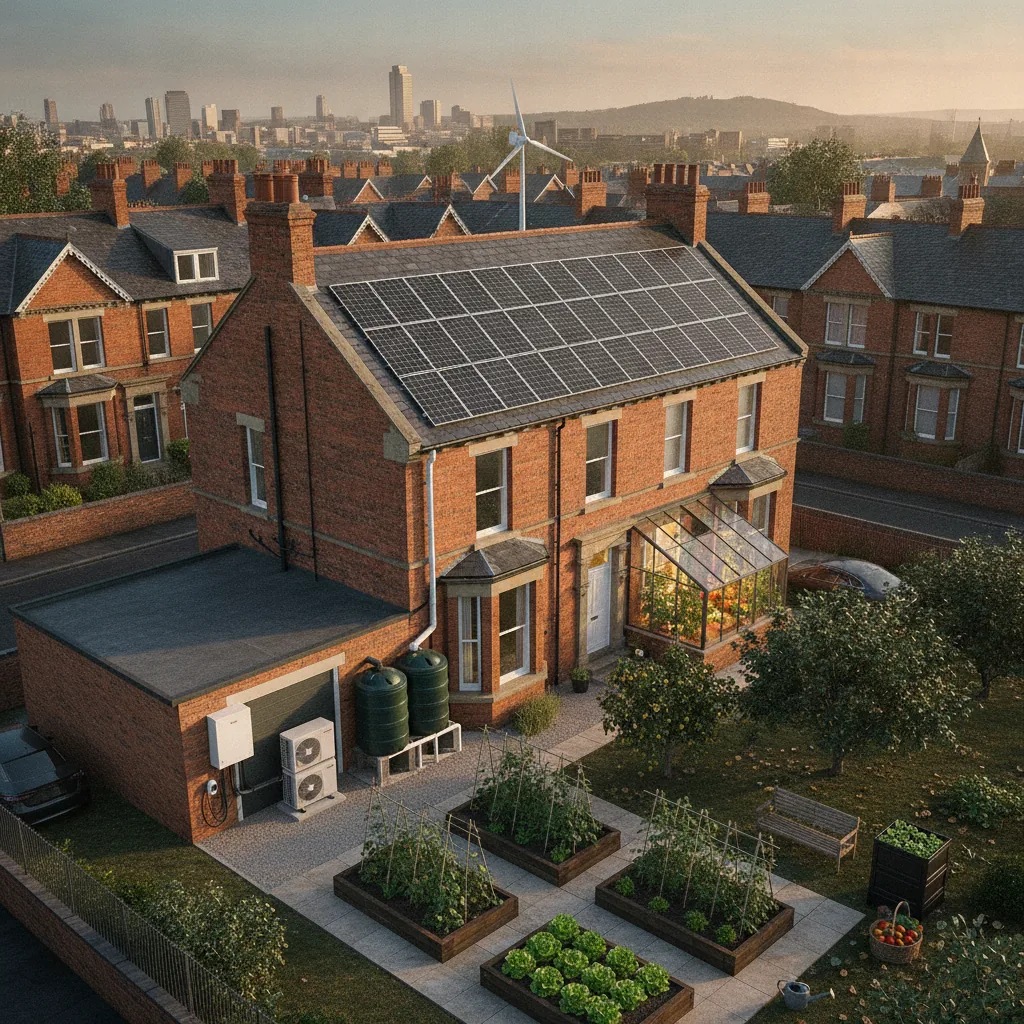
A typical home in Leeds can reach about 51% self-sufficiency with a right-sized solar, storage, rainwater and low-carbon heating setup — much of it backed by UK grants and 0% VAT. The figure sharpens once you enter your own home.
- ≈205 days a year off the grid — keep the fridge, lights, router and heating pump running straight from your own roof and battery, right through a winter outage.
- Rainwater self-reliance — ≈64,685 L harvested from a 100 m² roof covers the garden and toilet flushing, so hosepipe bans stop mattering.
- A real harvest — ≈229 kg of fresh vegetables over a ≈203-day frost-free season takes a genuine bite out of the weekly shop.
- A warm, low-bill winter — insulation plus a right-sized heat pump turns the local climate into low-carbon comfort and shields you from gas-price spikes.
From the most to the least profitable, here
What you could gain
-
Low-carbon heating37/100
~£2,835/yr
less heating after insulation + heat pump (−9,810 kWh/yr on 90 m², electric heating)
The detail
Realistic outlook
3,130 heating-degree-days: a high-efficiency heat pump is the lowest-carbon way to keep Leeds warm.
Watch-outs
A heat pump only pays off in a well-insulated envelope — insulate first, then size the unit.
Grants & tips
Boiler Upgrade Scheme: £7,500 towards an air-source heat pump (England & Wales); ECO4 and the Great British Insulation Scheme fund insulation, plus 0% VAT on heat pumps.
Heating-degree-days (base 18°C) : ≈ 3,130 HDD — Source: PVGIS, hourly ERA5 temperatures 2005–2015 (base 18°C).
-
Solar energy54/100
~£713/yr
less electricity with 3 kWp on your roof (≈2,853 kWh/yr)
The detail
Realistic outlook
At 951 kWh/kWp per year, Leeds offers solid potential for residential rooftop solar.
Watch-outs
Roof orientation, shading and DNO connection rules affect real output — get an MCS-certified site assessment first.
Grants & tips
Smart Export Guarantee (SEG): your supplier pays for surplus solar exported to the grid, plus 0% VAT on residential solar PV and battery storage until 2027.
Annual PV yield : 951 kWh/kWp — Source: PVGIS 5.2 (EU Joint Research Centre), optimal tilt and local horizon.
-
Food growing52/100
~£673/yr
off the weekly shop — up to ≈229 kg/yr of fresh vegetables from 100 m²
The detail
Realistic outlook
With about 203 frost-free days, a household garden in Leeds supports two planting rotations a year.
Watch-outs
A productive garden needs space, decent soil and a few hours a week — start small and scale up.
Grants & tips
Council allotments (Allotments Act) give cheap growing plots; RHS and community-garden schemes support home food production.
Frost-free growing season : ≈ 203 days — Source: PVGIS, hourly ERA5 temperatures 2005–2015 (frost dates).
-
Rainwater53/100
~£260/yr
less mains water with a 5,000 L tank (≈64,685 L/yr harvestable from a 100 m² roof)
The detail
Realistic outlook
761 mm of rain a year makes rooftop rainwater harvesting worthwhile in Leeds.
Watch-outs
Harvested rain is non-potable by default — keep it separate from drinking water and add a first-flush diverter.
Grants & tips
Many UK water companies offer subsidised or free water butts; on a metered supply, harvested rainwater cuts your water bill directly.
Average annual rainfall : 761 mm — Source: NASA POWER, MERRA-2 corrected precipitation.
£4,481
Ranked by annual value. The order of the works themselves does not change: insulate before you equip.
Estimate for Leeds, based on the area's climate and geographic data. Run the full simulation to get your home's real autonomy score — a personalized result and a detailed plan, in 3 minutes.
Everything is free — score, full report and action plan. No card, no commitment.
Estimate your solar system in Leeds
Estimate your solar system in Leeds
Based on a local yield of 951 kWh/kWp per year.
Indicative estimate (production = kWp × local yield). Real output depends on roof orientation, shading and your self-consumption rate.
What is specific to Leeds
Leeds went on building back-to-back terraces long after most towns had given them up. The council chose not to enforce the ban that the Public Health Act 1875 allowed, and improved back-to-backs were still going up until 1937, even though the form had been outlawed in 1909. They were built across working-class Harehills, Holbeck, Hunslet, Beeston and Armley, while Headingley and Kirkstall got larger through terraces. Most of this housing is red brick, thanks to clay deposits south of the city. In 2021, fewer than half of Leeds's privately owned or rented homes had an energy rating of C or better.
The council's retrofit schemes mix council, owner-occupied and privately rented homes so that whole streets, not scattered houses, are improved. In Holbeck, more than 150 back-to-backs are being upgraded as the first scheme of the £15.9m Heart of Holbeck programme. By October 2026, over 100 homes on streets such as Rydall Place, Shafton Street and Crosby Terrace had new roofs, insulated attic rooms, double glazing and external wall insulation with a brick-slip finish; the rest are due in spring 2027. A £4.4m scheme announced in 2024 for the Cedars area of Armley was also to include a study of ground-source heat pumps. In the district's 80 conservation areas, including Headingley, Chapel Allerton and Holbeck, cladding, rendering and some solar panels need planning permission.
The council's Leeds PIPES heat network takes steam from the Recycling and Energy Recovery Facility, where black-bin waste is burned, and turns it into hot water at the nearby Cross Green Energy Centre. By March 2026 it had more than 30 km of pipe and over 4,100 homes connected, more than 2,000 of them council flats. That month the council approved Hemiko to finance and run a new city-centre network, starting with the South Bank. Much of Leeds is covered by smoke control orders; the exceptions are mostly former industrial and outlying areas. The Warm Homes: Local Grant in Leeds is oversubscribed; Home Plus Leeds offers small free heating and energy-efficiency upgrades to some households earning under £30,000. In September 2026 the West Yorkshire Combined Authority launched a new Solar Together group-buying scheme.
Yorkshire Water imposed a hosepipe ban in 2022, its first in 27 years, and restrictions again in 2025. It needed none in summer 2026, but on 9 October the Environment Agency moved Yorkshire into drought status. The council has 101 allotment sites, most with their own committee or group, but no vacant plots, only a waiting list. A full 250 m² plot costs £81 for 2026–27, plus £22 for water, which is turned off from around the end of October until March. Feed Leeds, a food-growing network set up in 2011, lists Leeds Orchards and Little Veg Libraries among its current projects, while Morley and Rothwell mark two corners of the Rhubarb Triangle.
Sources
- Back-to-back house (Wikipedia)
- Architecture of Leeds (Wikipedia)
- Make your home more energy efficient – Leeds City Council
- Housing upgrade milestone is heartwarming news for Holbeck – Leeds City Council news (21 Oct 2026)
- Warm welcome for energy efficiency improvements to back-to-back homes – Leeds City Council news (31 Oct 2024)
- Conservation Areas – Leeds City Council
- About Leeds PIPES – Leeds PIPES
- Next phase of low-carbon heat network set to reach thousands more residents – Leeds City Council news (24 Mar 2026)
- Smoke control, air quality, light pollution and odour – Leeds City Council
- Solar Together scheme – West Yorkshire Combined Authority
- Yorkshire Water hosepipe ban to start on 26 August – BBC News (12 Aug 2022)
- Yorkshire reservoirs start road to recovery as stocks increase for first time in 13 weeks – Yorkshire Water (24 Sep 2026)
- No water restrictions expected for customers as Yorkshire moves into drought – Yorkshire Water (9 Oct 2026)
- Allotments – Leeds City Council
- About – Feed Leeds
- Rhubarb Triangle (Wikipedia)
Facts checked on 21 October 2026.
Climate month by month in Leeds
In Leeds, a 3 kWp array pitched at 41° and facing 3° east of south — the optimum PVGIS computes for this location — produces about 2,853 kWh a year. May is the strongest month, at about 348 kWh, and January the weakest, at 105 kWh. November to February bring 18% of the year's output — enough for a battery to cover winter evenings on sunny days, not through grey spells.
The heating season runs from September to June: 10 months average below 15 °C, and February is the coldest at 3.8 °C. In a typical year the coldest hours drop to about -3 °C, the point a heat pump has to be sized for: a standard air-to-water heat pump copes comfortably in an insulated house.
Frost is possible until mid-April and returns from early November, which leaves about 203 frost-free days; tender crops such as tomatoes, beans and squash go outside once mid-April is past. Days above 30 °C are rare, so summer care is mostly steady watering.
With a mean wind of 3.9 m/s at 10 m, a small rooftop turbine would produce little in Leeds; the roof is better used for solar. The southern horizon is open (at most 3.1°) in PVGIS's elevation model, so low winter sun reaches roofs unless nearby buildings block it.
Compared with Bradford, 14 km away, Leeds has 2% more solar yield, 2 more frost-free days and a heating need 6% lower. Compared with Sheffield, 46 km away, Leeds has the same solar yield, 2 fewer frost-free days and a heating need 2% lower.
| Month | Mean temperature | Solar output, 3 kWp |
|---|---|---|
| January | 4.0 °C | 105 kWh |
| February | 3.8 °C | 159 kWh |
| March | 5.5 °C | 255 kWh |
| April | 8.2 °C | 321 kWh |
| May | 10.9 °C | 348 kWh |
| June | 13.9 °C | 321 kWh |
| July | 16.1 °C | 342 kWh |
| August | 15.3 °C | 318 kWh |
| September | 13.5 °C | 261 kWh |
| October | 10.8 °C | 186 kWh |
| November | 6.9 °C | 132 kWh |
| December | 4.4 °C | 105 kWh |
Frequently asked questions — Leeds
How much could solar panels generate in Leeds?
A well-oriented 3 kWp rooftop array in Leeds produces about 2,853 kWh a year, worth roughly £713 in self-consumption. A 6 kWp system reaches about 5,706 kWh/yr where the roof allows. Smart Export Guarantee (SEG): your supplier pays for surplus solar exported to the grid, plus 0% VAT on residential solar PV and battery storage until 2027.
Is rainwater harvesting worth it in Leeds?
Yes. A 60 m² roof in Leeds can capture about 38,811 litres a year for the garden, WC and washing machine. Keep harvested rain separate from drinking water and fit a first-flush diverter. Many UK water companies offer subsidised or free water butts; on a metered supply, harvested rainwater cuts your water bill directly.
What grants help with low-carbon heating in Leeds?
Boiler Upgrade Scheme: £7,500 towards an air-source heat pump (England & Wales); ECO4 and the Great British Insulation Scheme fund insulation, plus 0% VAT on heat pumps. Insulate first — a heat pump only pays off in a well-insulated home (3,130 heating-degree-days here), so prioritise the roof and walls before sizing the unit.
How much food can a garden grow in Leeds?
With about 203 frost-free days, a 100 m² garden in Leeds yields roughly 229 kg of fresh fruit and vegetables a year — a partial share of a household's needs, not full calorie autonomy. Council allotments (Allotments Act) give cheap growing plots; RHS and community-garden schemes support home food production.
When is the last frost in Leeds?
Frost is possible until mid-April and returns from early November, which leaves about 203 frost-free days; tender crops such as tomatoes, beans and squash go outside once mid-April is past.
How much does solar produce in winter in Leeds?
January is the weakest month: a 3 kWp array makes about 105 kWh, against 348 kWh in May. November to February add up to 18% of the yearly total.
How this score is calculated
Public climate data (PVGIS, European Commission) weighted by how vital each dimension is. The score sharpens once you enter your own home. See the full methodology.
Sources
- Solar energy — Source: PVGIS 5.2 (EU Joint Research Centre), optimal tilt and local horizon.
- Rainwater — Source: NASA POWER, MERRA-2 corrected precipitation.
- Food growing — Source: PVGIS, hourly ERA5 temperatures 2005–2015 (frost dates).
- Low-carbon heating — Source: PVGIS, hourly ERA5 temperatures 2005–2015 (base 18°C).
Already ran your simulation?
your score is saved and re-scored every time your home changes. No credit card required.