Autonomy scoreLocal analysis
Seattle Home autonomy potential in Seattle (98101)
The strongest asset here is Rainwater. It is not, however, what pays your home the most: that is Low-carbon heating.
Annual potential, standard home
$2,933
Four items added up — each one is a separate decision, in whatever order suits you.
Overall score
57 /100
Growing
Seattle: 57/100 achievable autonomy with a recommended setup.
Solid potential — real, achievable gains in energy, water & food autonomy await.
What you could reach in Seattle
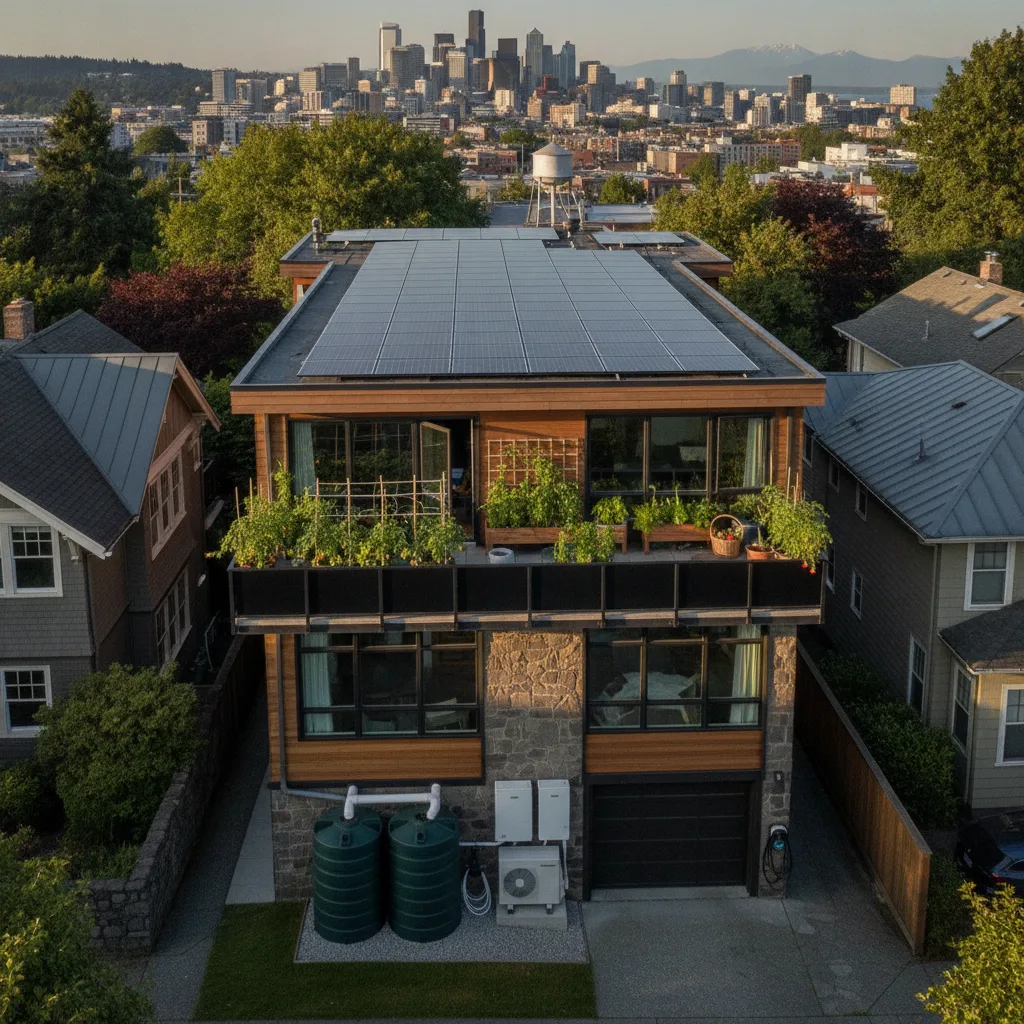
A typical home in Seattle can reach about 57% self-sufficiency with a right-sized solar, storage, rainwater and low-carbon heating setup — some of it eligible for state and utility rebates. The figure sharpens once you enter your own home.
- ≈163 days a year off the grid — keep the fridge, lights, router and heating pump running straight from your own roof and battery, right through a winter outage.
- Rainwater self-reliance — ≈104,465 L harvested from a 100 m² roof covers the garden and toilet flushing, so hosepipe bans stop mattering.
- A real harvest — ≈320 kg of fresh vegetables over a ≈285-day frost-free season takes a genuine bite out of the weekly shop.
- A warm, low-bill winter — insulation plus a right-sized heat pump turns the local climate into low-carbon comfort and shields you from gas-price spikes.
From the most to the least profitable, here
What you could gain
-
Low-carbon heating52/100
~$1,381/yr
less heating after insulation + heat pump (−8,370 kWh/yr on 90 m², electric heating)
The detail
Realistic outlook
2,690 heating-degree-days: a high-efficiency heat pump is the lowest-carbon way to keep Seattle warm.
Watch-outs
A heat pump only pays off in a well-insulated envelope — insulate first, then size the unit.
Incentives & tips
The federal Energy Efficient Home Improvement Credit (§25C) ended for work completed after December 31, 2025; HEEHRA state rebates, where your state runs them, still help with heat pumps and insulation.
Heating-degree-days (base 18°C): ≈ 2,690 HDD — Source: PVGIS, hourly ERA5 temperatures 2005–2015 (base 18°C).
-
Food growing70/100
~$896/yr
off the weekly shop — up to ≈320 kg/yr of fresh vegetables from 100 m²
The detail
Realistic outlook
With about 285 frost-free days, a household garden in Seattle supports up to three planting rotations a year.
Watch-outs
A productive garden needs space, decent soil and a few hours a week — start small and scale up.
Incentives & tips
USDA People's Garden and many municipal community-garden and composting programs support home food production.
Frost-free growing season: ≈ 285 days — Source: PVGIS, hourly ERA5 temperatures 2005–2015 (frost dates).
-
Solar energy35/100
~$456/yr
less electricity with 3 kWp on your roof (≈3,510 kWh/yr)
The detail
Realistic outlook
At 1,170 kWh/kWp per year, Seattle offers moderate potential for residential rooftop solar.
Watch-outs
Roof orientation, shading and local interconnection rules affect real output — get a site assessment first.
Incentives & tips
The federal Residential Clean Energy Credit (§25D) ended for work completed after December 31, 2025; rebates now come from states and utilities.
Annual PV yield: 1,170 kWh/kWp — Source: PVGIS 5.2 (EU Joint Research Centre), optimal tilt and local horizon.
-
Rainwater85/100
~$200/yr
less mains water with a 5,000 L tank (≈104,465 L/yr harvestable from a 100 m² roof)
The detail
Realistic outlook
1,229 mm of rain a year makes rooftop rainwater harvesting highly productive in Seattle.
Watch-outs
Harvested rain is non-potable by default — keep it separate from drinking water and add a first-flush diverter.
Incentives & tips
Rainwater incentives vary by state — e.g. Texas sales-tax exemption on harvesting equipment, local rebates in Arizona. Check state and city programs.
Average annual rainfall: 1,229 mm — Source: NASA POWER, MERRA-2 corrected precipitation.
$2,933
Ranked by annual value. The order of the works themselves does not change: insulate before you equip.
Estimate for Seattle, based on the area's climate and geographic data. Run the full simulation to get your home's real autonomy score — a personalized result and a detailed plan, in 3 minutes.
Everything is free — score, full report and action plan. No card, no commitment.
Estimate your solar system in Seattle
Estimate your solar system in Seattle
Based on a local yield of 1,170 kWh/kWp per year.
Indicative estimate (production = kWp × local yield). Real output depends on roof orientation, shading and your self-consumption rate.
What is specific to Seattle
Seattle has a high concentration of Craftsman bungalows, with wide, low-pitched gable or hipped roofs and broad eaves, alongside the Seattle Box, the local Foursquare with corner bay windows. Under SDCI Tip 420, updated in July 2025, a rooftop array on a single-family house may not need a building permit if the roof is a lightweight material such as shingle, the panels sit no more than 18 inches above it, and the system weighs no more than 5 pounds per square foot. An electrical permit is always required. Fire rules call for 3-foot access paths from eave to ridge on slopes with panels, though an array covering no more than a third of the roof can skip them if it leaves 18 inches clear on each side of the ridge. A solar permit doesn't exempt you from the city's tree rules. In the eight historic districts, among them Harvard-Belmont, Columbia City and Ballard Avenue, exterior changes need a Certificate of Approval before work starts, even when no building permit is required.
Under net metering, Seattle City Light credits power you send to the grid at your retail rate, for systems up to 100 kW AC. Exports aren't allowed in its network areas: most of Downtown and parts of First Hill, South Lake Union and the University District. City Light has begun planning the program's next phase and aims to give at least six months' notice before changes; a community solar program is still in design.
The Office of Sustainability and Environment estimates 8,000 to 10,000 homes still heat with oil, down from about 18,000 in 2018, and the city has pledged to help convert all of them by 2030. Its Clean Heat Program offers a $2,000 instant rebate for switching to a qualifying Mitsubishi Electric heat pump from a participating contractor, and households earning 81 to 150 percent of area median income can add a $4,000 state-funded bonus on installations completed by May 30, 2027. Households below that range may qualify for a free heat pump through the Office of Housing. Rebate participants must decommission the old oil tank to Seattle Fire Department requirements. The Puget Sound Clean Air Agency pays homeowners $500 to recycle an eligible old wood stove.
A 2009 Department of Ecology policy lets residents use rainwater from their roofs on the property where it's collected without a water right. RainWise, run by Seattle Public Utilities and King County, rebates up to the full cost of rain gardens and cisterns on eligible properties: those in mapped areas whose downspouts drain into the combined sewer. The city's roughly 90 P-Patch community gardens are named for the Picardo family; part of their Wedgwood truck farm became the first one in 1973. Plot holders, assigned from each garden's interest list, must garden organically and put in at least eight hours of community service a year.
Sources
- HistoryLink: Housebuilding in Seattle: A History
- SDCI Tip 420: Solar Energy Systems and Solar-Ready Roofs for Residential Buildings (updated July 14, 2025)
- Seattle Department of Neighborhoods: Historic Districts
- Seattle Department of Neighborhoods: Historic Preservation FAQ
- Seattle City Light: Solar Power
- Seattle City Light: Steps to Install or Upgrade a Solar Array (FAQ)
- Seattle Office of Sustainability and Environment: Seattle's Clean Heat Program
- Puget Sound Clean Air Agency: Wood Stove Recycling Program
- Washington Department of Ecology: Rainwater collection
- RainWise (King County / Seattle Public Utilities)
- RainWise: Eligibility
- Seattle Department of Neighborhoods: P-Patch Gardening
- Seattle Department of Neighborhoods: About the P-Patch Program
- Seattle Department of Neighborhoods: P-Patch Program Rules
Facts checked on October 21, 2026.
Climate month by month in Seattle
In Seattle, a 3 kWp array pitched at 38° and facing 8° west of south — the optimum PVGIS computes for this location — produces about 3,510 kWh a year. July is the strongest month, at about 450 kWh, and December the weakest, at 120 kWh. November to February bring 17% of the year's output — enough for a battery to cover winter evenings on sunny days, not through cloudy spells.
The heating season runs from October to June: 9 months average below 59 °F (15 °C), and December is the coldest at 41 °F (4.8 °C). In a typical year the coldest hours drop to about 30 °F (-1 °C), the point a heat pump has to be sized for: a standard air-to-water heat pump copes comfortably in an insulated house.
Frost is possible until mid-February and returns from late November, which leaves about 285 frost-free days; tender crops such as tomatoes, beans and squash go outside once mid-February is past. Days above 86 °F (30 °C) are rare, so summer care is mostly steady watering.
With a mean wind of 7 mph (3.1 m/s) at 10 m, a small rooftop turbine would produce little in Seattle; the roof is better used for solar. The southern horizon is open (at most 1.5°) in PVGIS's elevation model, so low winter sun reaches roofs unless nearby buildings block it.
Compared with Portland, 145 miles away, Seattle has 1% more solar yield, 48 more frost-free days and a similar heating need. Compared with San Francisco, 679 miles away, Seattle has 30% less solar yield, 80 fewer frost-free days and a heating need 49% higher.
| Month | Mean temperature | Solar output, 3 kWp |
|---|---|---|
| January | 42 °F (5.3 °C) | 132 kWh |
| February | 43 °F (6.0 °C) | 204 kWh |
| March | 46 °F (7.6 °C) | 285 kWh |
| April | 49 °F (9.2 °C) | 363 kWh |
| May | 55 °F (12.5 °C) | 411 kWh |
| June | 59 °F (14.9 °C) | 393 kWh |
| July | 64 °F (17.8 °C) | 450 kWh |
| August | 64 °F (17.6 °C) | 429 kWh |
| September | 59 °F (15.0 °C) | 339 kWh |
| October | 52 °F (11.2 °C) | 231 kWh |
| November | 45 °F (7.2 °C) | 153 kWh |
| December | 41 °F (4.8 °C) | 120 kWh |
Frequently asked questions — Seattle
How much could solar panels generate in Seattle?
A well-oriented 3 kWp rooftop array in Seattle produces about 3,510 kWh a year, worth roughly $456 in self-consumption. A 6 kWp system reaches about 7,020 kWh/yr where the roof allows. The federal Residential Clean Energy Credit (§25D) ended for work completed after December 31, 2025; rebates now come from states and utilities.
Is rainwater harvesting worth it in Seattle?
Yes. A 60 m² roof in Seattle can capture about 62,679 L a year for the garden, WC and washing machine. Keep harvested rain separate from drinking water and fit a first-flush diverter. Rainwater incentives vary by state — e.g. Texas sales-tax exemption on harvesting equipment, local rebates in Arizona. Check state and city programs.
What grants help with low-carbon heating in Seattle?
The federal Energy Efficient Home Improvement Credit (§25C) ended for work completed after December 31, 2025; HEEHRA state rebates, where your state runs them, still help with heat pumps and insulation. Insulate first — a heat pump only pays off in a well-insulated home (2,690 heating-degree-days here), so start with the roof and walls before sizing the unit.
How much food can a garden grow in Seattle?
With about 285 frost-free days, a 100 m² garden in Seattle yields roughly 320 kg of fresh fruit and vegetables a year — a partial share of a household's needs, not full calorie autonomy. USDA People's Garden and many municipal community-garden and composting programs support home food production.
When is the last frost in Seattle?
Frost is possible until mid-February and returns from late November, which leaves about 285 frost-free days; tender crops such as tomatoes, beans and squash go outside once mid-February is past.
How much does solar produce in winter in Seattle?
December is the weakest month: a 3 kWp array makes about 120 kWh, against 450 kWh in July. November to February add up to 17% of the yearly total.
How this score is calculated
Public climate data (PVGIS with NREL's NSRDB radiation) weighted by how vital each dimension is. The score sharpens once you enter your own home. See the full methodology.
Sources
- Solar energy — Source: PVGIS 5.2 (EU Joint Research Centre), optimal tilt and local horizon.
- Rainwater — Source: NASA POWER, MERRA-2 corrected precipitation.
- Food growing — Source: PVGIS, hourly ERA5 temperatures 2005–2015 (frost dates).
- Low-carbon heating — Source: PVGIS, hourly ERA5 temperatures 2005–2015 (base 18°C).
Already run your simulation?
your score is saved and re-scored every time your home changes. No credit card required.