Autonomy scoreLocal analysis
Los Angeles Home autonomy potential in Los Angeles (90001)
The strongest asset here is Low-carbon heating. It is not, however, what pays your home the most: that is Food growing.
Annual potential, standard home
$2,123
Four items added up — each one is a separate decision, in whatever order suits you.
Overall score
50 /100
Growing
Los Angeles: 50/100 achievable autonomy with a recommended setup.
Solid potential — real, achievable gains in energy, water & food autonomy await.
What you could reach in Los Angeles
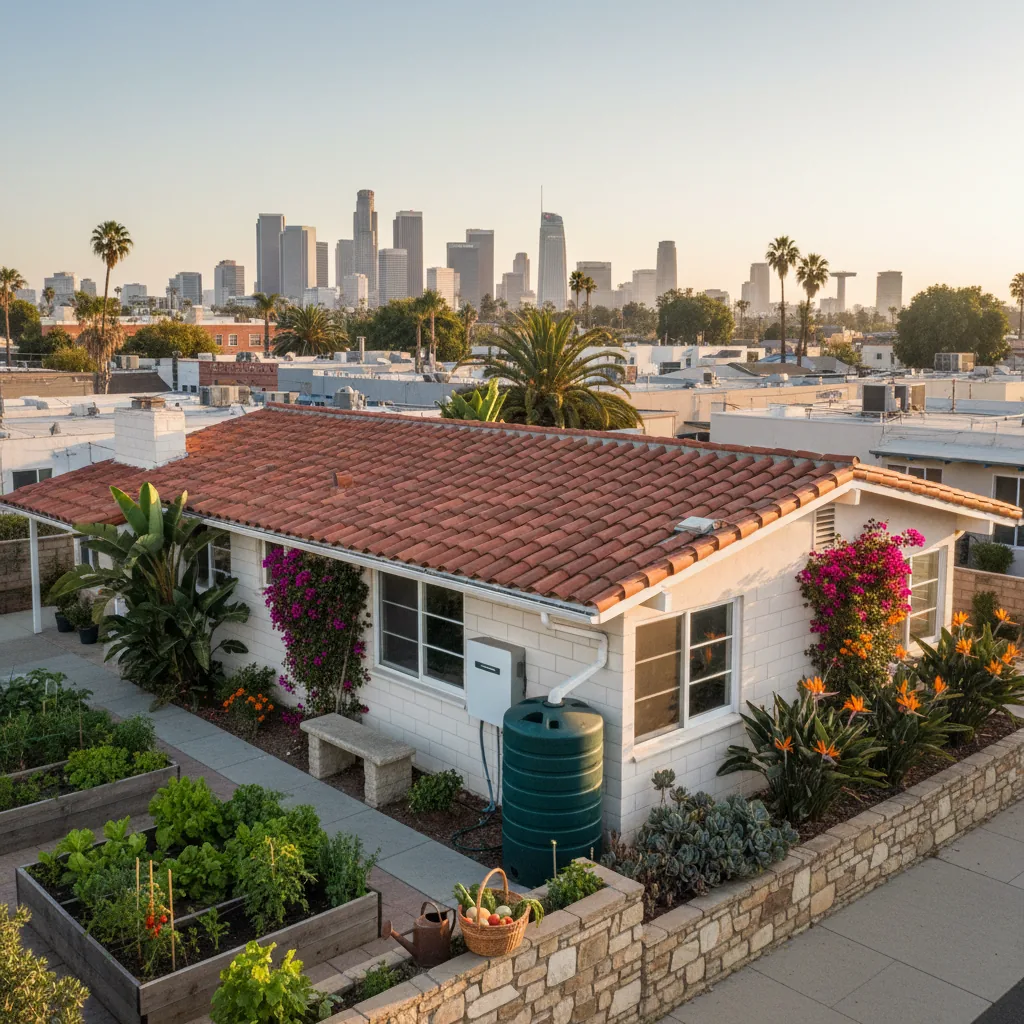
A typical home in Los Angeles can reach about 50% self-sufficiency with a right-sized solar, storage, rainwater and low-carbon heating setup — most of it backed by federal tax credits. The figure sharpens once you enter your own home.
- ≈176 days a year off the grid — keep the fridge, lights, router and heating pump running straight from your own roof and battery, right through a winter outage.
- Rainwater self-reliance — ≈28,220 L harvested from a 100 m² roof covers the garden and toilet flushing, so hosepipe bans stop mattering.
- A real harvest — ≈320 kg of fresh vegetables over a ≈364-day frost-free season takes a genuine bite out of the weekly shop.
- A warm, low-bill winter — insulation plus a right-sized heat pump turns the local climate into low-carbon comfort and shields you from gas-price spikes.
From the most to the least profitable, here
What you could gain
-
Food growing70/100
~$896/yr
off the weekly shop — up to ≈320 kg/yr of fresh vegetables from 100 m²
The detail
Realistic outlook
With about 364 frost-free days, a household garden in Los Angeles supports up to three planting rotations a year.
Watch-outs
A productive garden needs space, decent soil and a few hours a week — start small and scale up.
Incentives & tips
USDA People's Garden and many municipal community-garden and composting programs support home food production.
Frost-free growing season : ≈ 364 days — Source: PVGIS, hourly ERA5 temperatures 2005–2015 (frost dates).
-
Solar energy41/100
~$668/yr
less electricity with 3 kWp on your roof (≈5,139 kWh/yr)
The detail
Realistic outlook
At 1,713 kWh/kWp per year, Los Angeles offers moderate potential for residential rooftop solar.
Watch-outs
Roof orientation, shading and local interconnection rules affect real output — get a site assessment first.
Incentives & tips
Federal Residential Clean Energy Credit (IRA §25D): 30% tax credit on solar PV and battery storage through 2032.
Annual PV yield : 1,713 kWh/kWp — Source: PVGIS 5.2 (EU Joint Research Centre), optimal tilt and local horizon.
-
Low-carbon heating90/100
~$446/yr
less heating after insulation + heat pump (−2,700 kWh/yr on 90 m², electric heating)
The detail
Realistic outlook
870 heating-degree-days: a high-efficiency heat pump is the lowest-carbon way to keep Los Angeles warm.
Watch-outs
A heat pump only pays off in a well-insulated envelope — insulate first, then size the unit.
Incentives & tips
Energy Efficient Home Improvement Credit (§25C): up to $2,000/yr for heat pumps plus credits for insulation; HEEHRA state rebates may stack.
Heating-degree-days (base 18°C) : ≈ 870 HDD — Source: PVGIS, hourly ERA5 temperatures 2005–2015 (base 18°C).
-
Rainwater23/100
~$113/yr
less mains water with a 5,000 L tank (≈28,220 L/yr harvestable from a 100 m² roof)
The detail
Realistic outlook
With only 332 mm of rain a year, a tank in Los Angeles catches the few storms that come — useful for the garden, but a small contribution.
Watch-outs
Harvested rain is non-potable by default — keep it separate from drinking water and add a first-flush diverter.
Incentives & tips
Rainwater incentives vary by state — e.g. Texas sales-tax exemption on harvesting equipment, local rebates in Arizona. Check state and city programs.
Average annual rainfall : 332 mm — Source: NASA POWER, MERRA-2 corrected precipitation.
$2,123
Ranked by annual value. The order of the works themselves does not change: insulate before you equip.
Estimate for Los Angeles, based on the area's climate and geographic data. Run the full simulation to get your home's real autonomy score — a personalized result and a detailed plan, in 3 minutes.
Everything is free — score, full report and action plan. No card, no commitment.
Estimate your solar system in Los Angeles
Estimate your solar system in Los Angeles
Based on a local yield of 1,713 kWh/kWp per year.
Indicative estimate (production = kWp × local yield). Real output depends on roof orientation, shading and your self-consumption rate.
What is specific to Los Angeles
In the Highland Park–Garvanza Historic Preservation Overlay Zone, most historically significant homes are Craftsman bungalows, a style the district's preservation plan calls "refined in Los Angeles." City Planning reviews all exterior work proposed in an HPOZ, landscaping included. Under this plan, solar collectors on rear-facing or garage roofs that can't be seen from the street go to the Director of Planning instead of the HPOZ Board, while panels visible from the public right-of-way are "generally inappropriate."
Power comes from the Los Angeles Department of Water and Power (LADWP), whose LA100 Plan targets 100% carbon-free energy by 2035. Its Solar Rooftops program puts a utility-owned 1–10 kW system on an owner-occupied home and pays the owner $360 to $900 a year for up to 20 years; LADWP keeps the power. Households at or below 80% of Area Median Income can seek state Self-Generation Incentive Program funds for solar and batteries through LADWP, which warns of a long waitlist. The Consumer Rebate Program pays up to $2,500 per heat-pump water heater, or per ton for the most efficient ductless heat pumps, bought and installed since November 1, 2025. Attic insulation installed since September 1, 2025, earns $0.30 to $0.50 per square foot.
More than 80% of LADWP's water is imported, and the city remains in Phase 2 of its Emergency Water Conservation Plan: sprinklers run three days a week, by odd or even address, and no outdoor watering is allowed from 9 a.m. to 4 p.m. Through the Metropolitan Water District's SoCal Water$mart program, customers can claim up to $50 per rain barrel or up to $500 for a cistern of at least 200 gallons, and $5 per square foot, with pre-approval, to replace lawn with California Friendly plants, mulch or rain capture.
Urban farming has a contested history here: the 14-acre South Central Farm at 41st and Alameda was worked from 1994 until its farmers were evicted in 2006. Municipal Code Section 62.169(b) lets owners of residential lots with one to ten units plant edibles in the parkway without a permit, provided plants stay under 36 inches, are kept clear of the sidewalk and are harvested promptly; raised beds there still need permits. LA Sanitation gives away mulch, plus limited TOPGRO compost, at self-serve sites from Lopez Canyon to San Pedro.
Two measures aimed at gas equipment stalled in 2025. On June 6 the South Coast AQMD board voted 7 to 5 against proposed amendments to its nitrogen-oxide rules for gas furnaces and water heaters, and the City Council repealed its 2022 all-electric ordinance for new buildings, effective October 13, citing the Ninth Circuit's Berkeley ruling. AQMD Rule 445 still bars, with narrow exceptions, permanently installing wood-burning devices in development begun since March 9, 2009, and No-Burn days, called from November through February when fine-particle pollution is forecast to be unhealthy, ban residential wood fires.
Sources
- Highland Park–Garvanza HPOZ Preservation Plan (LA City Planning)
- Local Historic Districts (HPOZs) (LA City Planning)
- Clean Energy Future / LA100 Plan (LADWP)
- Solar Rooftops (LADWP)
- Self-Generation Incentive Program (LADWP)
- Consumer Rebate Program (LADWP)
- Attic Insulation Rebate Program (LADWP)
- Water Conservation & Ordinance (LADWP)
- Residential SoCal Water $mart Water Rebate Program (LADWP)
- South Central Farm (Wikipedia)
- Parkway Landscaping Guidelines (StreetsLA)
- Free Mulch and TOPGRO Compost (LA Sanitation & Environment)
- Proposed Amended Rules 1111 and 1121 (South Coast AQMD)
- Ordinance No. 188716 (LA City Clerk)
- Rule 445 – Wood-Burning Devices (South Coast AQMD)
- Check Before You Burn (South Coast AQMD)
Facts checked on October 21, 2026.
Climate month by month in Los Angeles
In Los Angeles, a 3 kWp array pitched at 32° and facing 11° west of south — the optimum PVGIS computes for this location — produces about 5,139 kWh a year. August is the strongest month, at about 507 kWh, and December the weakest, at 336 kWh. November to February still bring 28% of the year's output, so the system stays useful all winter and a battery pays its way year-round.
The heating season runs from December to March: 4 months average below 59 °F (15 °C), and December is the coldest at 53 °F (11.5 °C). In a typical year the coldest hours drop to about 37 °F (3 °C), the point a heat pump has to be sized for: mild conditions, the easiest case for any heat pump.
Frost is practically absent from a typical year in Los Angeles, so the garden can produce in every season; the limits are summer heat and water, not cold. Expect about 56 days above 86 °F (30 °C): shade netting and mulch matter as much as frost protection, and the water tank is drawn hardest in August.
With a mean wind of 4 mph (1.9 m/s) at 10 m, a small rooftop turbine would produce little in Los Angeles; the roof is better used for solar. The southern horizon is open (at most 1.9°) in PVGIS's elevation model, so low winter sun reaches roofs unless nearby buildings block it.
Compared with San Diego, 112 miles away, Los Angeles has 10% more solar yield, 1 fewer frost-free day and a heating need 7% higher. Compared with Las Vegas, 228 miles away, Los Angeles has 6% less solar yield, 61 more frost-free days and a heating need 24% lower.
| Month | Mean temperature | Solar output, 3 kWp |
|---|---|---|
| January | 54 °F (12.0 °C) | 354 kWh |
| February | 55 °F (12.6 °C) | 357 kWh |
| March | 58 °F (14.4 °C) | 450 kWh |
| April | 61 °F (15.9 °C) | 468 kWh |
| May | 65 °F (18.2 °C) | 480 kWh |
| June | 69 °F (20.3 °C) | 459 kWh |
| July | 73 °F (23.0 °C) | 483 kWh |
| August | 74 °F (23.5 °C) | 507 kWh |
| September | 73 °F (22.8 °C) | 447 kWh |
| October | 67 °F (19.3 °C) | 423 kWh |
| November | 60 °F (15.5 °C) | 381 kWh |
| December | 53 °F (11.5 °C) | 336 kWh |
Frequently asked questions — Los Angeles
How much could solar panels generate in Los Angeles?
A well-oriented 3 kWp rooftop array in Los Angeles produces about 5,139 kWh a year, worth roughly $668 in self-consumption. A 6 kWp system reaches about 10,278 kWh/yr where the roof allows. Federal Residential Clean Energy Credit (IRA §25D): 30% tax credit on solar PV and battery storage through 2032.
Is rainwater harvesting worth it in Los Angeles?
Yes. A 60 m² roof in Los Angeles can capture about 16,932 litres a year for the garden, WC and washing machine. Keep harvested rain separate from drinking water and fit a first-flush diverter. Rainwater incentives vary by state — e.g. Texas sales-tax exemption on harvesting equipment, local rebates in Arizona. Check state and city programs.
What grants help with low-carbon heating in Los Angeles?
Energy Efficient Home Improvement Credit (§25C): up to $2,000/yr for heat pumps plus credits for insulation; HEEHRA state rebates may stack. Insulate first — a heat pump only pays off in a well-insulated home (870 heating-degree-days here), so prioritise the roof and walls before sizing the unit.
How much food can a garden grow in Los Angeles?
With about 364 frost-free days, a 100 m² garden in Los Angeles yields roughly 320 kg of fresh fruit and vegetables a year — a partial share of a household's needs, not full calorie autonomy. USDA People's Garden and many municipal community-garden and composting programs support home food production.
When is the last frost in Los Angeles?
Frost is practically absent from a typical year in Los Angeles, so the garden can produce in every season; the limits are summer heat and water, not cold.
How much does solar produce in winter in Los Angeles?
December is the weakest month: a 3 kWp array makes about 336 kWh, against 507 kWh in August. November to February add up to 28% of the yearly total.
How this score is calculated
Public climate data (PVGIS with NREL's NSRDB radiation) weighted by how vital each dimension is. The score sharpens once you enter your own home. See the full methodology.
Sources
- Solar energy — Source: PVGIS 5.2 (EU Joint Research Centre), optimal tilt and local horizon.
- Rainwater — Source: NASA POWER, MERRA-2 corrected precipitation.
- Food growing — Source: PVGIS, hourly ERA5 temperatures 2005–2015 (frost dates).
- Low-carbon heating — Source: PVGIS, hourly ERA5 temperatures 2005–2015 (base 18°C).
Already ran your simulation?
your score is saved and re-scored every time your home changes. No credit card required.