Autonomy scoreLocal analysis
Chicago Home autonomy potential in Chicago (60601)
The strongest asset here is Rainwater. It is not, however, what pays your home the most: that is Low-carbon heating.
Annual potential, standard home
$3,162
Four items added up — each one is a separate decision, in whatever order suits you.
Overall score
48 /100
Growing
Chicago: 48/100 achievable autonomy with a recommended setup.
Solid potential — real, achievable gains in energy, water & food autonomy await.
What you could reach in Chicago
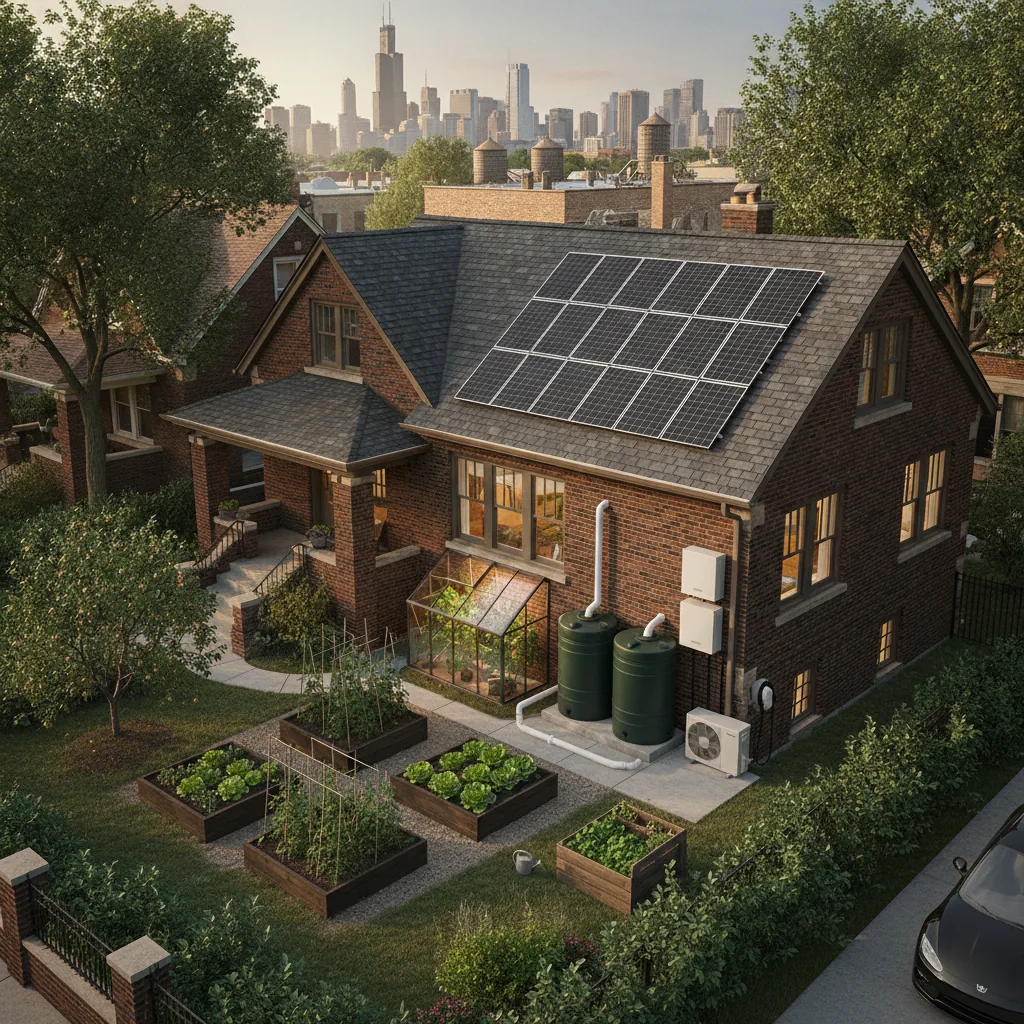
A typical home in Chicago can reach about 48% self-sufficiency with a right-sized solar, storage, rainwater and low-carbon heating setup — most of it backed by federal tax credits. The figure sharpens once you enter your own home.
- ≈165 days a year off the grid — keep the fridge, lights, router and heating pump running straight from your own roof and battery, right through a winter outage.
- Rainwater self-reliance — ≈83,385 L harvested from a 100 m² roof covers the garden and toilet flushing, so hosepipe bans stop mattering.
- A real harvest — ≈254 kg of fresh vegetables over a ≈223-day frost-free season takes a genuine bite out of the weekly shop.
- A warm, low-bill winter — insulation plus a right-sized heat pump turns the local climate into low-carbon comfort and shields you from gas-price spikes.
From the most to the least profitable, here
What you could gain
-
Low-carbon heating30/100
~$1,737/yr
less heating after insulation + heat pump (−10,530 kWh/yr on 90 m², electric heating)
The detail
Realistic outlook
3,350 heating-degree-days: a high-efficiency heat pump is the lowest-carbon way to keep Chicago warm.
Watch-outs
A heat pump only pays off in a well-insulated envelope — insulate first, then size the unit.
Incentives & tips
Energy Efficient Home Improvement Credit (§25C): up to $2,000/yr for heat pumps plus credits for insulation; HEEHRA state rebates may stack.
Heating-degree-days (base 18°C) : ≈ 3,350 HDD — Source: PVGIS, hourly ERA5 temperatures 2005–2015 (base 18°C).
-
Food growing58/100
~$711/yr
off the weekly shop — up to ≈254 kg/yr of fresh vegetables from 100 m²
The detail
Realistic outlook
With about 223 frost-free days, a household garden in Chicago supports two planting rotations a year.
Watch-outs
A productive garden needs space, decent soil and a few hours a week — start small and scale up.
Incentives & tips
USDA People's Garden and many municipal community-garden and composting programs support home food production.
Frost-free growing season : ≈ 223 days — Source: PVGIS, hourly ERA5 temperatures 2005–2015 (frost dates).
-
Solar energy36/100
~$514/yr
less electricity with 3 kWp on your roof (≈3,957 kWh/yr)
The detail
Realistic outlook
At 1,319 kWh/kWp per year, Chicago offers moderate potential for residential rooftop solar.
Watch-outs
Roof orientation, shading and local interconnection rules affect real output — get a site assessment first.
Incentives & tips
Federal Residential Clean Energy Credit (IRA §25D): 30% tax credit on solar PV and battery storage through 2032.
Annual PV yield : 1,319 kWh/kWp — Source: PVGIS 5.2 (EU Joint Research Centre), optimal tilt and local horizon.
-
Rainwater68/100
~$200/yr
less mains water with a 5,000 L tank (≈83,385 L/yr harvestable from a 100 m² roof)
The detail
Realistic outlook
981 mm of rain a year makes rooftop rainwater harvesting highly productive in Chicago.
Watch-outs
Harvested rain is non-potable by default — keep it separate from drinking water and add a first-flush diverter.
Incentives & tips
Rainwater incentives vary by state — e.g. Texas sales-tax exemption on harvesting equipment, local rebates in Arizona. Check state and city programs.
Average annual rainfall : 981 mm — Source: NASA POWER, MERRA-2 corrected precipitation.
$3,162
Ranked by annual value. The order of the works themselves does not change: insulate before you equip.
Estimate for Chicago, based on the area's climate and geographic data. Run the full simulation to get your home's real autonomy score — a personalized result and a detailed plan, in 3 minutes.
Everything is free — score, full report and action plan. No card, no commitment.
Estimate your solar system in Chicago
Estimate your solar system in Chicago
Based on a local yield of 1,319 kWh/kWp per year.
Indicative estimate (production = kWp × local yield). Real output depends on roof orientation, shading and your self-consumption rate.
What is specific to Chicago
The Chicago Bungalow Association counts more than 80,000 bungalows still standing, nearly a third of the city's single-family homes. The classic version, built from 1910 to the mid-1930s, is brick, a story and a half over a basement, under a low-pitched hipped roof with wide overhangs. Homes in the 15 National Register bungalow districts, including Gage Park, Hermosa and Avalon Park, can qualify for the state's Property Tax Assessment Freeze: an owner-occupant who spends more than 25 percent of the assessor's market value on an approved rehab within 24 months gets an eight-year assessment freeze, then a four-year phase-in. The Commission on Chicago Landmarks separately reviews alterations to city landmarks and landmark districts, so check an address before roof or facade work.
Small-scale solar PV systems are permitted through the Department of Buildings' Express Permit Program, which replaced the Solar Express Permit process on November 6, 2023, and also covers reroofing. Illinois Shines offers state incentives for on-site and community solar with no income requirement, while Illinois Solar for All helps income-eligible households install panels with no upfront cost.
In February 2025 the Illinois Commerce Commission ordered Peoples Gas, the city's gas utility, to abandon its approach to a pipe replacement program that had run far over its initial $1.4 billion estimate and to focus on replacing cast-iron and ductile-iron pipe, 1,112 miles of it under Chicago streets, by 2035. For owners ready to leave gas, the Chicago Bungalow Association and ComEd run Whole Home Electric, which can install heat pumps, heat pump water heaters and induction stoves at no cost for income-eligible owners of single-family homes and two-flats. Its 2026 funding is fully allocated; applications are still processed, but service isn't guaranteed.
Chicago's water comes from Lake Michigan; the Department of Water Management allows sprinkling from 5 to 8 a.m. and 7 to 10 p.m. on weekdays, with no limits on weekends and holidays. To ease basement flooding and sewer overflows, the city encourages owners to disconnect downspouts, which needs no permit, and the Metropolitan Water Reclamation District sells 55-gallon rain barrels to Cook County residents for $22.30 delivered, two per household. A house or two-flat built before 1986 likely has a lead service line; the city's Equity Lead Service Line Replacement program replaces it free for owner-occupants earning below 80 percent of area median income, as funding allows.
For growing food, NeighborSpace, a nonprofit founded with the City, the Chicago Park District and the Forest Preserve District of Cook County, takes ownership of community-established gardens so they stay protected. Growers can buy city-owned lots for urban agriculture through ChiBlockBuilder for $1 each, committing to farm them for ten years and to be selling or providing produce to communities short on healthy food within five years. A round of more than 450 lots for all uses opened Oct. 1, 2026; applications are due Nov. 16.
Sources
- The Chicago Bungalow - Chicago Bungalow Association
- Bungalow Historic Districts - Chicago Bungalow Association
- Property Tax Assessment Freeze summary - Illinois State Historic Preservation Office
- Commission on Chicago Landmarks - City of Chicago
- Express Permit Program - Chicago Department of Buildings
- Illinois Shines - Illinois Power Agency
- Trump pulls plug on expanding solar program that cuts Illinois electric bills - NPR Illinois (Oct. 2, 2025)
- Illinois Solar for All - Illinois Power Agency
- State cracks down on Chicago gas utility as other utilities ask for rate increase - NPR Illinois / Capitol News Illinois (Feb. 21, 2025)
- Whole Home Electric - Chicago Bungalow Association
- Water Conservation - Chicago Department of Water Management
- Downspout Disconnection - Chicago Department of Water Management
- Rain Barrels - Metropolitan Water Reclamation District of Greater Chicago
- Lead Service Line Replacement - Lead-Safe Chicago (City of Chicago)
- Equity Lead Service Line Replacement Program - Lead-Safe Chicago (City of Chicago)
- Open Spaces - Neighbor Space Gardens (City of Chicago data portal, via data.gov)
- Urban Agriculture - ChiBlockBuilder, City of Chicago
- ChiBlockBuilder - City of Chicago Department of Planning and Development
Facts checked on October 21, 2026.
Climate month by month in Chicago
In Chicago, a 3 kWp array pitched at 35° and facing due south — the optimum PVGIS computes for this location — produces about 3,957 kWh a year. July is the strongest month, at about 438 kWh, and December the weakest, at 162 kWh. November to February bring 21% of the year's output — enough for a battery to cover winter evenings on sunny days, not through grey spells.
The heating season runs from October to April: 7 months average below 59 °F (15 °C), and February is the coldest at 24 °F (-4.4 °C). In a typical year the coldest hours drop to about 3 °F (-16 °C), the point a heat pump has to be sized for: choose a cold-climate model rated for that temperature, or keep a backup heat source.
Frost is possible until early April and returns from mid-November, which leaves about 223 frost-free days; tender crops such as tomatoes, beans and squash go outside once early April is past. About 21 days pass 86 °F (30 °C), so water early in the morning during heatwaves.
Mean wind at 10 m is 10 mph (4.4 m/s): borderline for a small turbine, which would need an exposed, unobstructed mast to pay off. The southern horizon is open (at most 0.0°) in PVGIS's elevation model, so low winter sun reaches roofs unless nearby buildings block it.
Compared with Indianapolis, 165 miles away, Chicago has 1% less solar yield, 20 more frost-free days and a heating need 17% higher. Compared with Detroit, 237 miles away, Chicago has 3% more solar yield, 16 more frost-free days and a heating need 2% lower.
| Month | Mean temperature | Solar output, 3 kWp |
|---|---|---|
| January | 25 °F (-4.1 °C) | 201 kWh |
| February | 24 °F (-4.4 °C) | 243 kWh |
| March | 36 °F (2.4 °C) | 357 kWh |
| April | 48 °F (9.1 °C) | 390 kWh |
| May | 60 °F (15.7 °C) | 414 kWh |
| June | 71 °F (21.6 °C) | 417 kWh |
| July | 75 °F (24.1 °C) | 438 kWh |
| August | 74 °F (23.4 °C) | 417 kWh |
| September | 67 °F (19.3 °C) | 363 kWh |
| October | 55 °F (12.5 °C) | 312 kWh |
| November | 42 °F (5.6 °C) | 243 kWh |
| December | 30 °F (-0.9 °C) | 162 kWh |
Frequently asked questions — Chicago
How much could solar panels generate in Chicago?
A well-oriented 3 kWp rooftop array in Chicago produces about 3,957 kWh a year, worth roughly $514 in self-consumption. A 6 kWp system reaches about 7,914 kWh/yr where the roof allows. Federal Residential Clean Energy Credit (IRA §25D): 30% tax credit on solar PV and battery storage through 2032.
Is rainwater harvesting worth it in Chicago?
Yes. A 60 m² roof in Chicago can capture about 50,031 litres a year for the garden, WC and washing machine. Keep harvested rain separate from drinking water and fit a first-flush diverter. Rainwater incentives vary by state — e.g. Texas sales-tax exemption on harvesting equipment, local rebates in Arizona. Check state and city programs.
What grants help with low-carbon heating in Chicago?
Energy Efficient Home Improvement Credit (§25C): up to $2,000/yr for heat pumps plus credits for insulation; HEEHRA state rebates may stack. Insulate first — a heat pump only pays off in a well-insulated home (3,350 heating-degree-days here), so prioritise the roof and walls before sizing the unit.
How much food can a garden grow in Chicago?
With about 223 frost-free days, a 100 m² garden in Chicago yields roughly 254 kg of fresh fruit and vegetables a year — a partial share of a household's needs, not full calorie autonomy. USDA People's Garden and many municipal community-garden and composting programs support home food production.
When is the last frost in Chicago?
Frost is possible until early April and returns from mid-November, which leaves about 223 frost-free days; tender crops such as tomatoes, beans and squash go outside once early April is past.
How much does solar produce in winter in Chicago?
December is the weakest month: a 3 kWp array makes about 162 kWh, against 438 kWh in July. November to February add up to 21% of the yearly total.
How this score is calculated
Public climate data (PVGIS with NREL's NSRDB radiation) weighted by how vital each dimension is. The score sharpens once you enter your own home. See the full methodology.
Sources
- Solar energy — Source: PVGIS 5.2 (EU Joint Research Centre), optimal tilt and local horizon.
- Rainwater — Source: NASA POWER, MERRA-2 corrected precipitation.
- Food growing — Source: PVGIS, hourly ERA5 temperatures 2005–2015 (frost dates).
- Low-carbon heating — Source: PVGIS, hourly ERA5 temperatures 2005–2015 (base 18°C).
Already ran your simulation?
your score is saved and re-scored every time your home changes. No credit card required.