Autonomy scoreLocal analysis
Charlotte Home autonomy potential in Charlotte (28202)
Here, Low-carbon heating is both the best score and the biggest annual gain for your home.
Annual potential, standard home
$2,410
Four items added up — each one is a separate decision, in whatever order suits you.
Overall score
60 /100
Advanced
Charlotte: 60/100 achievable autonomy with a recommended setup.
Strong potential — high self-sufficiency in energy, water & food is well within reach.
What you could reach in Charlotte
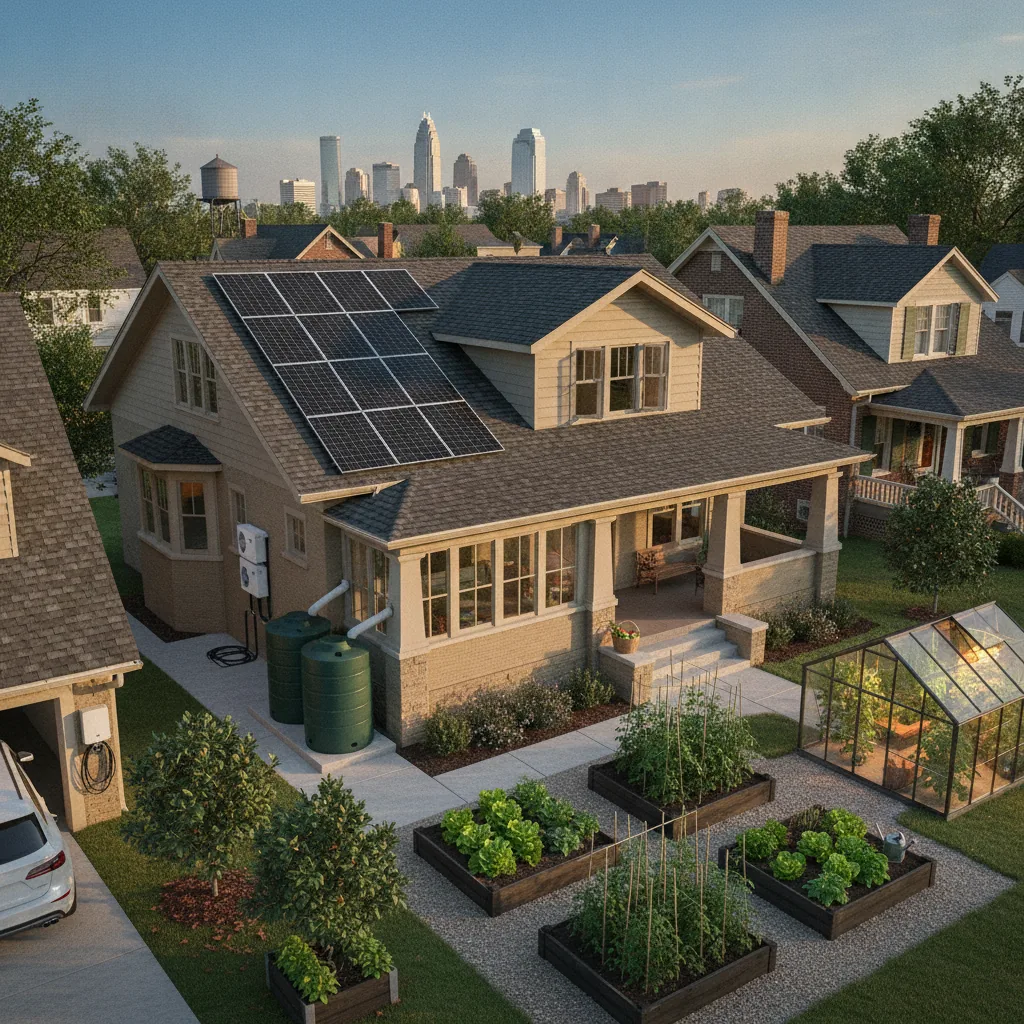
A typical home in Charlotte can reach about 60% self-sufficiency with a right-sized solar, storage, rainwater and low-carbon heating setup — most of it backed by federal tax credits. The figure sharpens once you enter your own home.
- ≈170 days a year off the grid — keep the fridge, lights, router and heating pump running straight from your own roof and battery, right through a winter outage.
- Rainwater self-reliance — ≈97,325 L harvested from a 100 m² roof covers the garden and toilet flushing, so hosepipe bans stop mattering.
- A real harvest — ≈273 kg of fresh vegetables over a ≈238-day frost-free season takes a genuine bite out of the weekly shop.
- A warm, low-bill winter — insulation plus a right-sized heat pump turns the local climate into low-carbon comfort and shields you from gas-price spikes.
From the most to the least profitable, here
What you could gain
-
Low-carbon heating84/100
~$876/yr
less heating after insulation + heat pump (−5,310 kWh/yr on 90 m², electric heating)
The detail
Realistic outlook
1,680 heating-degree-days: a high-efficiency heat pump is the lowest-carbon way to keep Charlotte warm.
Watch-outs
A heat pump only pays off in a well-insulated envelope — insulate first, then size the unit.
Incentives & tips
Energy Efficient Home Improvement Credit (§25C): up to $2,000/yr for heat pumps plus credits for insulation; HEEHRA state rebates may stack.
Heating-degree-days (base 18°C) : ≈ 1,680 HDD — Source: PVGIS, hourly ERA5 temperatures 2005–2015 (base 18°C).
-
Food growing63/100
~$764/yr
off the weekly shop — up to ≈273 kg/yr of fresh vegetables from 100 m²
The detail
Realistic outlook
With about 238 frost-free days, a household garden in Charlotte supports two planting rotations a year.
Watch-outs
A productive garden needs space, decent soil and a few hours a week — start small and scale up.
Incentives & tips
USDA People's Garden and many municipal community-garden and composting programs support home food production.
Frost-free growing season : ≈ 238 days — Source: PVGIS, hourly ERA5 temperatures 2005–2015 (frost dates).
-
Solar energy38/100
~$570/yr
less electricity with 3 kWp on your roof (≈4,383 kWh/yr)
The detail
Realistic outlook
At 1,461 kWh/kWp per year, Charlotte offers moderate potential for residential rooftop solar.
Watch-outs
Roof orientation, shading and local interconnection rules affect real output — get a site assessment first.
Incentives & tips
Federal Residential Clean Energy Credit (IRA §25D): 30% tax credit on solar PV and battery storage through 2032.
Annual PV yield : 1,461 kWh/kWp — Source: PVGIS 5.2 (EU Joint Research Centre), optimal tilt and local horizon.
-
Rainwater79/100
~$200/yr
less mains water with a 5,000 L tank (≈97,325 L/yr harvestable from a 100 m² roof)
The detail
Realistic outlook
1,145 mm of rain a year makes rooftop rainwater harvesting highly productive in Charlotte.
Watch-outs
Harvested rain is non-potable by default — keep it separate from drinking water and add a first-flush diverter.
Incentives & tips
Rainwater incentives vary by state — e.g. Texas sales-tax exemption on harvesting equipment, local rebates in Arizona. Check state and city programs.
Average annual rainfall : 1,145 mm — Source: NASA POWER, MERRA-2 corrected precipitation.
$2,410
Ranked by annual value. The order of the works themselves does not change: insulate before you equip.
Estimate for Charlotte, based on the area's climate and geographic data. Run the full simulation to get your home's real autonomy score — a personalized result and a detailed plan, in 3 minutes.
Everything is free — score, full report and action plan. No card, no commitment.
Estimate your solar system in Charlotte
Estimate your solar system in Charlotte
Based on a local yield of 1,461 kWh/kWp per year.
Indicative estimate (production = kWp × local yield). Real output depends on roof orientation, shading and your self-consumption rate.
Climate month by month in Charlotte
In Charlotte, a 3 kWp array pitched at 34° and facing 3° east of south — the optimum PVGIS computes for this location — produces about 4,383 kWh a year. May is the strongest month, at about 414 kWh, and December the weakest, at 288 kWh. November to February still bring 29% of the year's output, so the system stays useful all winter and a battery pays its way year-round.
The heating season runs from November to March: 5 months average below 59 °F (15 °C), and January is the coldest at 41 °F (5.2 °C). In a typical year the coldest hours drop to about 27 °F (-3 °C), the point a heat pump has to be sized for: a standard air-to-water heat pump copes comfortably in an insulated house.
Frost is possible until late March and returns from mid-November, which leaves about 238 frost-free days; tender crops such as tomatoes, beans and squash go outside once late March is past. Expect about 80 days above 86 °F (30 °C): shade netting and mulch matter as much as frost protection, and the water tank is drawn hardest in July.
With a mean wind of 5 mph (2.1 m/s) at 10 m, a small rooftop turbine would produce little in Charlotte; the roof is better used for solar. The southern horizon is open (at most 0.0°) in PVGIS's elevation model, so low winter sun reaches roofs unless nearby buildings block it.
Compared with Washington, 330 miles away, Charlotte has 6% more solar yield, 8 more frost-free days and a heating need 30% lower. Compared with Nashville, 339 miles away, Charlotte has 7% more solar yield, as many frost-free days and a heating need 13% lower.
| Month | Mean temperature | Solar output, 3 kWp |
|---|---|---|
| January | 41 °F (5.2 °C) | 330 kWh |
| February | 43 °F (6.1 °C) | 333 kWh |
| March | 51 °F (10.7 °C) | 396 kWh |
| April | 61 °F (16.1 °C) | 405 kWh |
| May | 70 °F (20.9 °C) | 414 kWh |
| June | 78 °F (25.4 °C) | 399 kWh |
| July | 80 °F (26.7 °C) | 387 kWh |
| August | 79 °F (26.1 °C) | 381 kWh |
| September | 73 °F (22.9 °C) | 348 kWh |
| October | 62 °F (16.5 °C) | 372 kWh |
| November | 51 °F (10.5 °C) | 330 kWh |
| December | 46 °F (7.6 °C) | 288 kWh |
Frequently asked questions — Charlotte
How much could solar panels generate in Charlotte?
A well-oriented 3 kWp rooftop array in Charlotte produces about 4,383 kWh a year, worth roughly $570 in self-consumption. A 6 kWp system reaches about 8,766 kWh/yr where the roof allows. Federal Residential Clean Energy Credit (IRA §25D): 30% tax credit on solar PV and battery storage through 2032.
Is rainwater harvesting worth it in Charlotte?
Yes. A 60 m² roof in Charlotte can capture about 58,395 litres a year for the garden, WC and washing machine. Keep harvested rain separate from drinking water and fit a first-flush diverter. Rainwater incentives vary by state — e.g. Texas sales-tax exemption on harvesting equipment, local rebates in Arizona. Check state and city programs.
What grants help with low-carbon heating in Charlotte?
Energy Efficient Home Improvement Credit (§25C): up to $2,000/yr for heat pumps plus credits for insulation; HEEHRA state rebates may stack. Insulate first — a heat pump only pays off in a well-insulated home (1,680 heating-degree-days here), so prioritise the roof and walls before sizing the unit.
How much food can a garden grow in Charlotte?
With about 238 frost-free days, a 100 m² garden in Charlotte yields roughly 273 kg of fresh fruit and vegetables a year — a partial share of a household's needs, not full calorie autonomy. USDA People's Garden and many municipal community-garden and composting programs support home food production.
When is the last frost in Charlotte?
Frost is possible until late March and returns from mid-November, which leaves about 238 frost-free days; tender crops such as tomatoes, beans and squash go outside once late March is past.
How much does solar produce in winter in Charlotte?
December is the weakest month: a 3 kWp array makes about 288 kWh, against 414 kWh in May. November to February add up to 29% of the yearly total.
How this score is calculated
Public climate data (PVGIS with NREL's NSRDB radiation) weighted by how vital each dimension is. The score sharpens once you enter your own home. See the full methodology.
Sources
- Solar energy — Source: PVGIS 5.2 (EU Joint Research Centre), optimal tilt and local horizon.
- Rainwater — Source: NASA POWER, MERRA-2 corrected precipitation.
- Food growing — Source: PVGIS, hourly ERA5 temperatures 2005–2015 (frost dates).
- Low-carbon heating — Source: PVGIS, hourly ERA5 temperatures 2005–2015 (base 18°C).
Already ran your simulation?
your score is saved and re-scored every time your home changes. No credit card required.